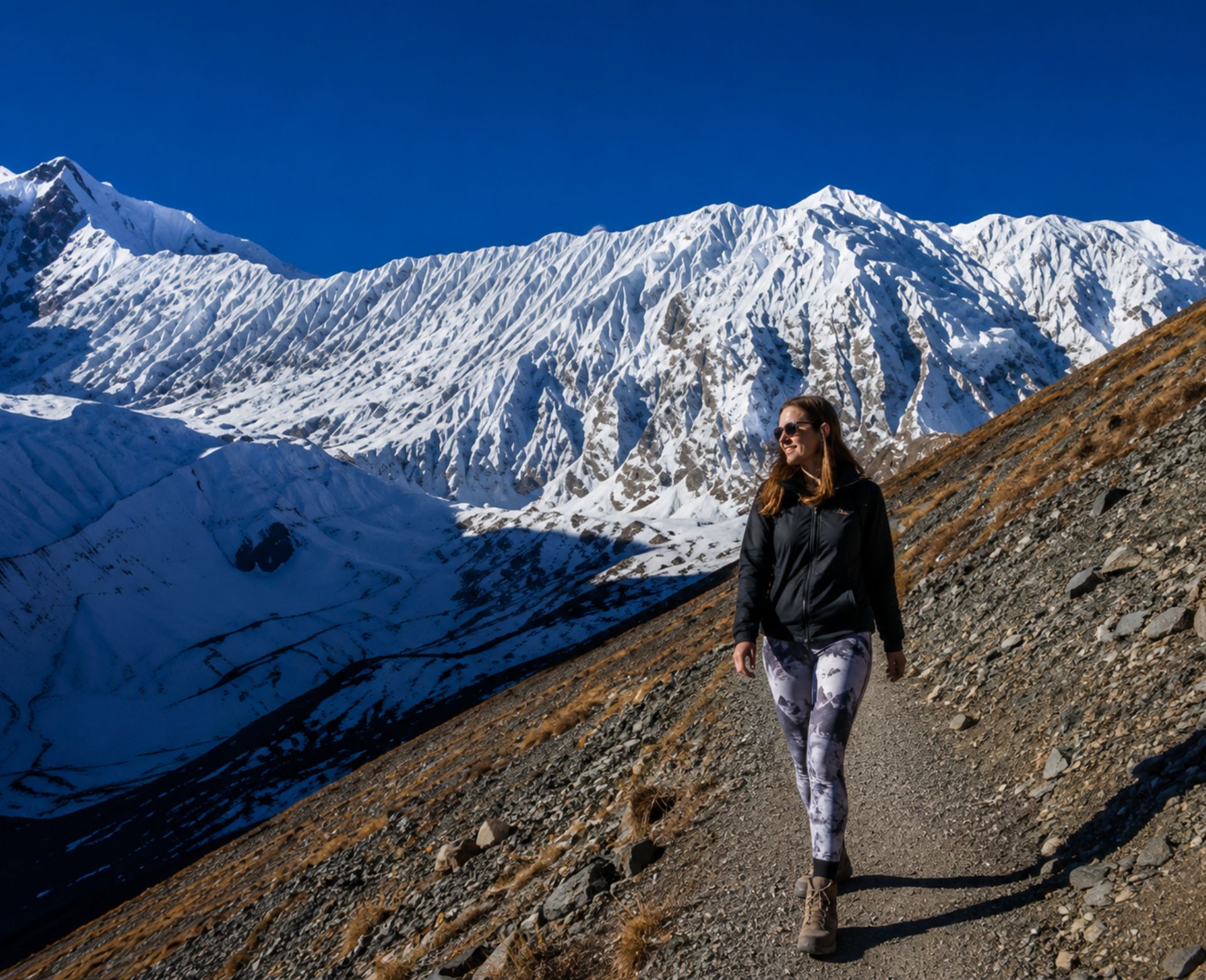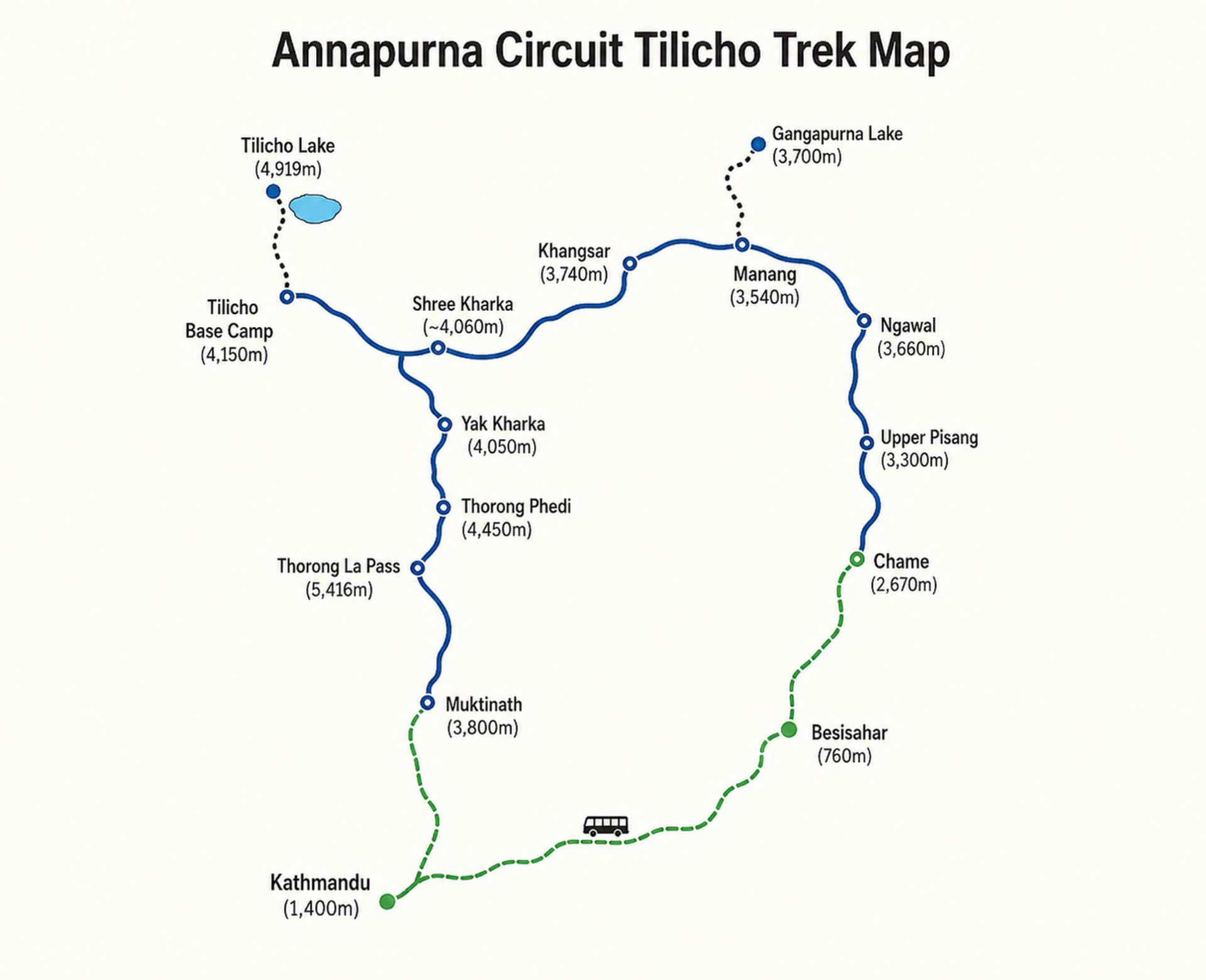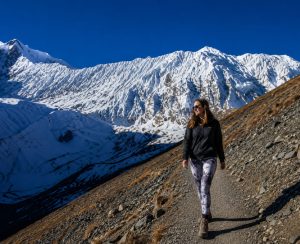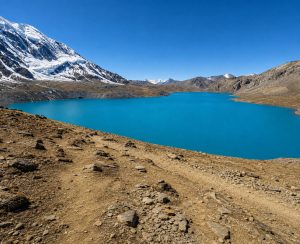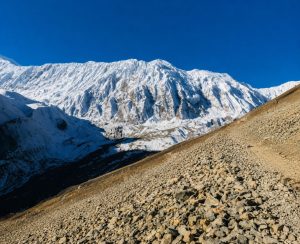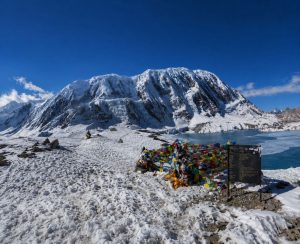
The Annapurna Circuit Tilicho Trek is a 13-day guided trek from Kathmandu, priced from $778 to $1,148 per person. It combines the classic Circuit over Thorong La Pass with a detour to Tilicho Lake. Tilicho is one of the highest freshwater lakes in the world. Instead of the standard trail from Manang to Yak Kharka, this itinerary branches to Tilicho Base Camp. It visits the lake at 4,919m, then rejoins the main trail over the pass.
The route starts with a drive from Kathmandu to Besisahar. From there, it follows the Marsyangdi Valley through Chame, Upper Pisang, Ngawal, and Manang. These are the same opening days as the standard Circuit. After acclimatising in Manang, the trail turns toward Tilicho instead of Yak Kharka.
Beyond the pass, the trail descends to Muktinath, where trekking ends. From there, it’s a direct drive to Pokhara — no Jomsom, no Kali Gandaki return, no Poon Hill.
Customise it with Upper Mustang, extra time at Manang or Muktinath, or continuing to Annapurna Base Camp afterward.
| Trip Details | Information |
|---|---|
| Trip Name | Annapurna Circuit with Tilicho Lake Trek |
| Duration | 12 Nights / 13 Days |
| Maximum Altitude | 5,416m — Thorong La Pass |
| Tilicho Lake Altitude | 4,919m |
| Trek Difficulty | Challenging (High-Altitude Trek) |
| Trek Start Point | Besisahar (Lamjung) |
| Trek End Point | Muktinath, then drive to Pokhara |
| Best Season | Spring (March–May) & Autumn (September–November) |
| Low Season | Winter — cold temperatures, quieter trails |
| Not Recommended | Peak Monsoon (July–August) |
| Accommodation | Tea House Lodges |
| Meals Included | Breakfast, Lunch & Dinner (during trek) |
| Permits Required | ACAP + TIMS |
| Trek Style | Guided High-Altitude Himalayan Trek with Tilicho Lake Extension |
| Region | Annapurna & Mustang |
Kathmandu → Besisahar → Chame → Upper Pisang → Ngawal → Manang → Shree Kharka → Tilicho Base Camp → Tilicho Lake → Tilicho Base Camp → Yak Kharka → Thorong Phedi → Thorong La Pass → Muktinath → Pokhara
Most trekkers do the Circuit or the Tilicho detour — rarely both in one route with the acclimatisation math worked out. This trek does both, in the sequence that makes sense: Tilicho Lake comes before Thorong La, so the extra altitude exposure at 4,919m works in your favour rather than adding fresh risk after an already-crossed pass.
The detour changes the middle days completely. Instead of Manang straight to Yak Kharka, the route pushes west into remote terrain — Shree Kharka, the landslide-prone approach to Tilicho Base Camp, and the lake itself in its glacial bowl, with almost nobody else there. Then it rejoins the main trail — Yak Kharka, Thorong Phedi, the pass at dawn — exactly where the standard Circuit would have been anyway.
Ending at Muktinath keeps this trek focused — a direct drive to Pokhara, no Kali Gandaki return, no Poon Hill. Want those too? The standard Circuit covers them.
This route is rated challenging, a step up from the standard Circuit’s moderate-to-challenging rating. The traverse to Tilicho Base Camp crosses genuinely landslide-prone terrain, and the altitude sequence is real: you reach 4,919m at the lake, descend briefly, then climb again to cross Thorong La at 5,416m within days. Thirteen days is shorter than the standard Circuit, but the terrain and altitude exposure ask more of you per day, not less. Six to eight weeks of serious uphill fitness work beforehand isn’t optional here — it’s the difference between managing the Tilicho detour comfortably and struggling through it.
per person
per person
per person
per person
Altitude: 760m | Drive: 6–7 hours (local bus) | Meals: Lunch, Dinner | Stay: Besisahar
The drive west out of Kathmandu follows the Trishuli and Marsyangdi rivers. It passes through terraced hillsides, small market towns, and rural villages that thin out as the valley narrows. Besisahar is the traditional gateway to the Annapurna Circuit. It’s the last night on flat ground before the mountains take over. It’s a long day in the vehicle, but it puts you at the trailhead rested rather than road-worn. You’ll be ready for the real climbing that starts tomorrow.
Altitude: 2,670m | Drive: 5–6 hours (shared local jeep or bus) | Meals: Breakfast, Lunch, Dinner | Stay: Chame
The mountain road climbs through Syange, Jagat, and Dharapani along the Marsyangdi River. Waterfalls cut the valley walls, with the river always somewhere below. Chame at 2,670m delivers the first clear, unobstructed mountain view as the valley finally opens up. We keep this a road day too, on purpose. The real trekking starts tomorrow, and you’ll want the legs for it.
Altitude: 3,300m | Trek: 5–6 hours | Meals: Breakfast, Lunch, Dinner | Stay: Upper Pisang
From Chame, the trail climbs through pine forest and rocky cliffs into the Bhratang gorge. There, Paungda Danda — the “Gateway to Heaven” rock wall — rises suddenly above you across the river. It’s hundreds of metres high and entirely unannounced. Annapurna II (7,937m) appears above the valley as the trail climbs into Upper Pisang. It’s a hillside village with some of the widest mountain views on the lower circuit.
Altitude: 3,660m | Trek: 4–5 hours | Meals: Breakfast, Lunch, Dinner | Stay: Ngawal
As the trail drops toward the valley floor below Upper Pisang, Green Lake (Mring Tal) sits in the basin. Turquoise water throws back a near-perfect mirror of the Paungda Danda rock face and Annapurna II behind it. It’s the finest photography stop on the circuit, and worth the extra few minutes. The trail then climbs steeply through Ghyaru village, with Annapurna II, III, and the full Manang Valley opening up. You reach Ngawal at 3,660m.
Altitude: 3,540m | Trek: 4–5 hours | Meals: Breakfast, Lunch, Dinner | Stay: Manang
The trail descends gradually through Braga and Humde. These are Tibetan-influenced villages with monasteries that have stood for centuries. Beyond them, the Manang Valley opens wide around you. Gangapurna (7,455m), Annapurna III, and the Chulu peaks surround the village on arrival. Withdraw your cash at the Manang ATM tonight. There’s no ATM anywhere on the Tilicho detour, and the next one after Manang is a long way off.
Altitude: 3,540m | Hike: 3–4 hours | Meals: Breakfast, Lunch, Dinner | Stay: Manang
Morning: the hike up to Gangapurna Lake at 3,700m. It’s a glacial lake sitting directly beneath Gangapurna’s south face, with the glacier reflected across the water. It’s the most popular acclimatisation hike on the circuit, and the most effective one. Gaining altitude for a few hours, then sleeping back down at Manang, follows the “climb high, sleep low” pattern. It’s exactly what your body needs before the Tilicho detour begins. Afternoon: the free HRA altitude medicine lecture in Manang, essential before both Tilicho and Thorong La. This rest day matters more on this itinerary than on the standard circuit. You’re about to spend two nights above 4,000m before the pass even comes into view.
Altitude: ~4,060m | Trek: 5–6 hours | Meals: Breakfast, Lunch, Dinner | Stay: Shree Kharka
This is where the route leaves the standard circuit trail. Instead of continuing toward Yak Kharka, the path turns west along the Khangsar valley. It passes the old Tibetan village of Khangsar and the centuries-old Tare Gumpa monastery. The landscape empties out fast here — fewer trekkers, fewer teahouses. It’s a remote feel that the main circuit trail doesn’t have. Shree Kharka is a small settlement, basic but adequate, and the last proper stop before the terrain gets serious.
Altitude: 4,150m | Trek: 5–6 hours | Meals: Breakfast, Lunch, Dinner | Stay: Tilicho Base Camp
The trail today crosses a section prone to landslides — narrow and exposed. That’s why your guide sets the pace here rather than letting anyone rush ahead. Take it slowly and carefully. Tilicho Base Camp itself is basic — simple teahouse accommodation at 4,150m. But the views of Tilicho Peak and the surrounding wall of mountains from the dining room window are extraordinary. Eat a full dinner and sleep early. Tomorrow’s the lake.
Altitude: 4,919m | Trek: 6–7 hours round trip | Meals: Breakfast, Lunch, Dinner | Stay: Tilicho Base Camp
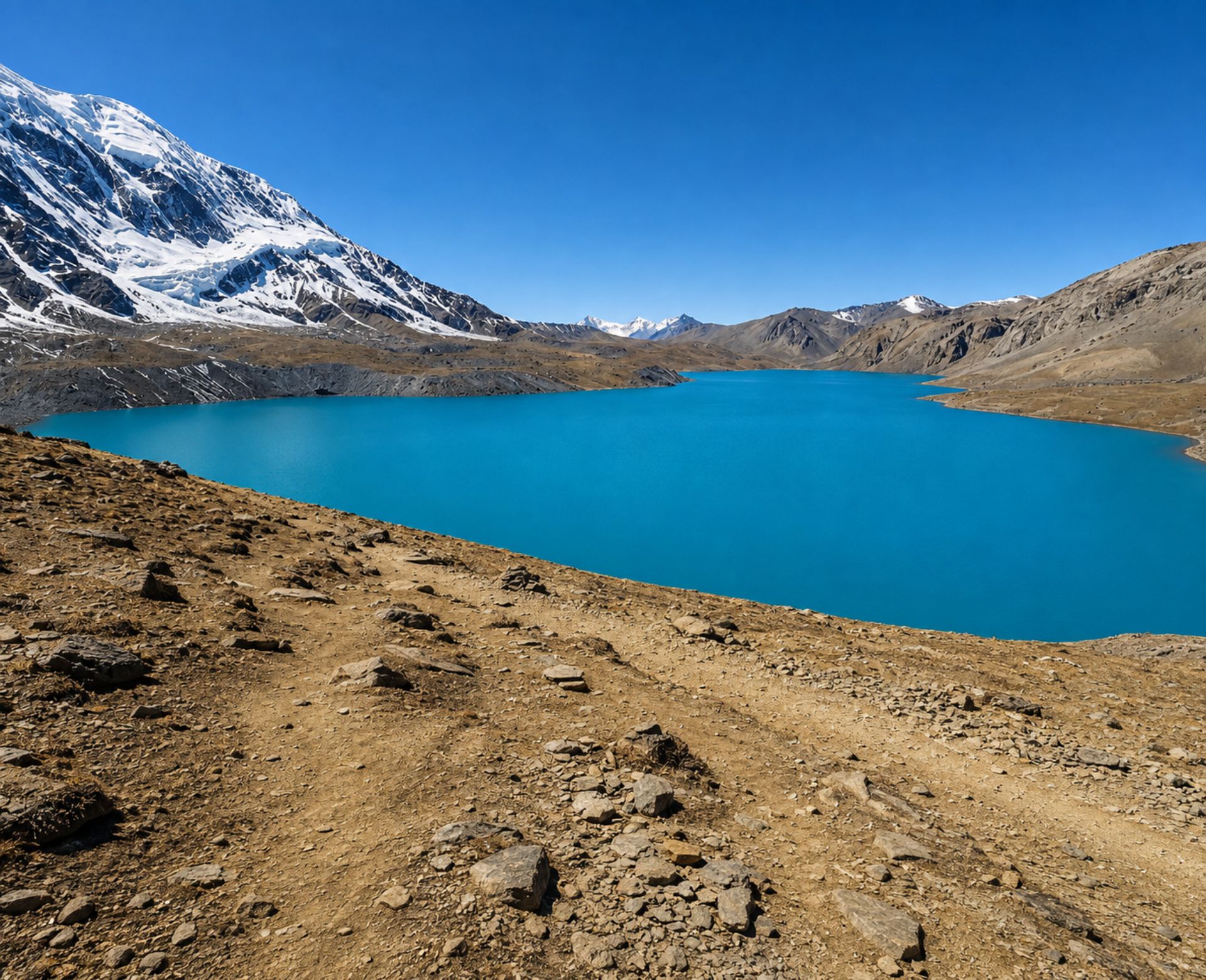
An early start, before the afternoon wind picks up. The climb to Tilicho Lake gains close to 800m from Base Camp. It’s steep, on loose moraine, and genuinely demanding at this altitude. Then the lake itself: one of the highest freshwater lakes in the world. It’s ice-cold and startlingly still, sitting in a glacial bowl below Tilicho Peak’s north face. Almost nobody else is there. After time at the lake, it’s the same route back down to Tilicho Base Camp for a second night. This is the highest point before the pass itself, so treat today with the same respect you’d give Thorong La.
Altitude: 4,050m | Trek: 5–6 hours | Meals: Breakfast, Lunch, Dinner | Stay: Yak Kharka
The trail rejoins the main Annapurna Circuit trail today. It follows a higher route above Khangsar village, past the ruins of old settlements. Then it descends to cross the Thorong Khola on an old log bridge. From here, the trek you already know picks up. Yak Kharka sits on the main circuit trail. Every trekker doing the standard route without Tilicho passes through here too. Pastures, occasional yak herds, and a proper night’s rest before the final push toward the pass.
Altitude: 4,450m | Trek: 3–4 hours | Meals: Breakfast, Lunch, Dinner | Stay: Thorong Phedi
A short but demanding climb to Thorong Phedi, the last camp before the pass. The afternoon is deliberately unhurried — rest, eat, prepare for the 4am start. Eat the full dinner even when your appetite has mostly disappeared by this point. Tomorrow doesn’t forgive a poor one tonight. Sleep by 7pm. The alarm goes off at 3:30am.
Altitude: 5,416m (Thorong La) / 3,800m (Muktinath) | Trek: 6–7 hours | Meals: Breakfast, Lunch, Dinner | Stay: Muktinath
Departure at 4:00–4:30am, in darkness and cold. The ascent gains 966m from Thorong Phedi to the summit at 5,416m. It’s a steady, deliberate, conversational pace the entire way — no exceptions. Prayer flags mark the top, and the views open up across to Dhaulagiri. Dhaulagiri sits on the far side of the Kali Gandaki. Then comes 1,616m of descent on steep, rocky terrain down to Muktinath. Muktinath is the most sacred Hindu and Buddhist pilgrimage site in Nepal. This is the day both halves of this trek — the lake and the pass — have been building toward. It delivers on both counts.
Altitude: 820m | Drive: 7–8 hours (direct road) | Meals: Breakfast, Lunch
The day starts with a visit to Muktinath Temple — the holy fire, the 108 water spouts, the ancient monastery. Then it’s a long single-day drive along the Kali Gandaki valley road. The route passes through Jomsom and Kagbeni, then Tatopani, on to Pokhara. It’s a full day in the vehicle covering a substantial altitude drop. There’s no overnight stop en route — one direct push to Pokhara. Phewa Lake, a warm shower, and thirteen days of pass and lake behind you. Done.
This itinerary adds a genuine detour to Tilicho Lake — one of the highest freshwater lakes in the world at 4,919m. It reaches the lake before crossing Thorong La Pass, rather than following the standard Circuit route straight from Manang to Yak Kharka. It also ends differently. The trek finishes at Muktinath with a direct drive to Pokhara. That skips the Kali Gandaki walking return through Tatopani, Ghorepani, and Poon Hill that the standard 15-day Circuit includes. At 13 days, it’s actually 2 days shorter than the standard route, despite the extra Tilicho detour.
Rated challenging — a step up from the standard Circuit’s moderate-to-challenging rating. The added demand comes from two consecutive nights above 4,000m at Tilicho Base Camp, plus a genuinely hard summit push to the lake at 4,919m. All of that comes before the Thorong La crossing at 5,416m even begins. No technical climbing is involved anywhere on the route. Eight to ten weeks of outdoor-specific training is recommended beforehand, and prior high-altitude experience is a real advantage. For the standard Circuit’s difficulty profile for comparison: Annapurna Circuit Difficulty →
13 days from Kathmandu to Pokhara. Days 1–2 are road transfers to Chame. Days 3–9 cover the trek through Manang and the Tilicho detour, including the acclimatisation day and two nights at Tilicho Base Camp. Days 10–12 rejoin the main circuit trail and cross Thorong La to Muktinath. Day 13 is a direct drive from Muktinath back to Pokhara.
Two permits apply: the Annapurna Conservation Area Permit (ACAP) and the TIMS card. ACAP costs NPR 3,000 (~USD 23) and is compulsory for this route. We also include the TIMS card in the package price, at the agency rate of NPR 1,000 (~USD 8). Independent trekkers applying without an agency pay NPR 2,000 instead. Together, that’s roughly USD 31 per person. The ACAP covers the Tilicho detour as well — no separate or special permit is needed for the lake itself. Mountain Hike Nepal arranges both before departure, and your guide handles all checkpoint presentations.
Yes, meaningfully. This itinerary spends two consecutive nights above 4,000m at Tilicho Base Camp (4,150m), with a summit push to 4,919m in between. That comes before the standard Circuit’s own altitude demands even begin, at Thorong Phedi and the pass. The Manang acclimatisation day is mandatory on every Mountain Hike Nepal departure, specifically because of this extra exposure. Your guide carries a pulse oximeter and monitors oxygen saturation from Manang onward, through both Tilicho and the pass.
No — this itinerary ends at Muktinath with a direct drive to Pokhara. It skips the Kali Gandaki walking return through Jomsom, Tatopani, Ghorepani, and Poon Hill entirely. If you want those sections as well as Tilicho Lake, the standard 15-day Circuit itinerary covers the full walking return. This route is built specifically for trekkers who want Tilicho Lake and Thorong La without extending the trip further. For the full walking-return itinerary: Standard Annapurna Circuit Trek →
Yes — after the drive from Muktinath to Pokhara, this trek can be combined with a full Annapurna Base Camp trek. Together, that makes a longer trip of roughly three weeks. The two itineraries run as separate bookings joined at Pokhara, not one continuous trail. Contact Mountain Hike Nepal to build the full combination into one itinerary, or see the standalone Annapurna Base Camp Trek package →.
October and November are the finest months, with post-monsoon clarity and the most stable conditions. That applies to both the Tilicho detour and the Thorong La crossing. March and April are the best spring months, with generally stable weather before the pre-monsoon cloud builds. The trail to Tilicho Base Camp crosses landslide-prone terrain, so conditions matter more here than on the standard Circuit. Avoid the monsoon months of June through August entirely. Avoid December through February too, unless you have significant cold-weather, high-altitude experience.
The Mountain Hike Nepal package starts from USD 778 per person for groups of 8–12, and USD 1,148 for solo trekkers. That includes guide, porter, all permits, all meals on the trail, teahouse accommodation, and all ground transport. It’s less than the standard 15-day Circuit package, even though it includes the Tilicho detour. That’s because this itinerary is 2 days shorter overall, by skipping the Jomsom-Tatopani-Poon Hill walking return.
Plan every aspect of your Circuit Tilicho trek with these detailed guides — most cover the shared Annapurna Circuit route in full, with the Tilicho-specific details covered above on this page: