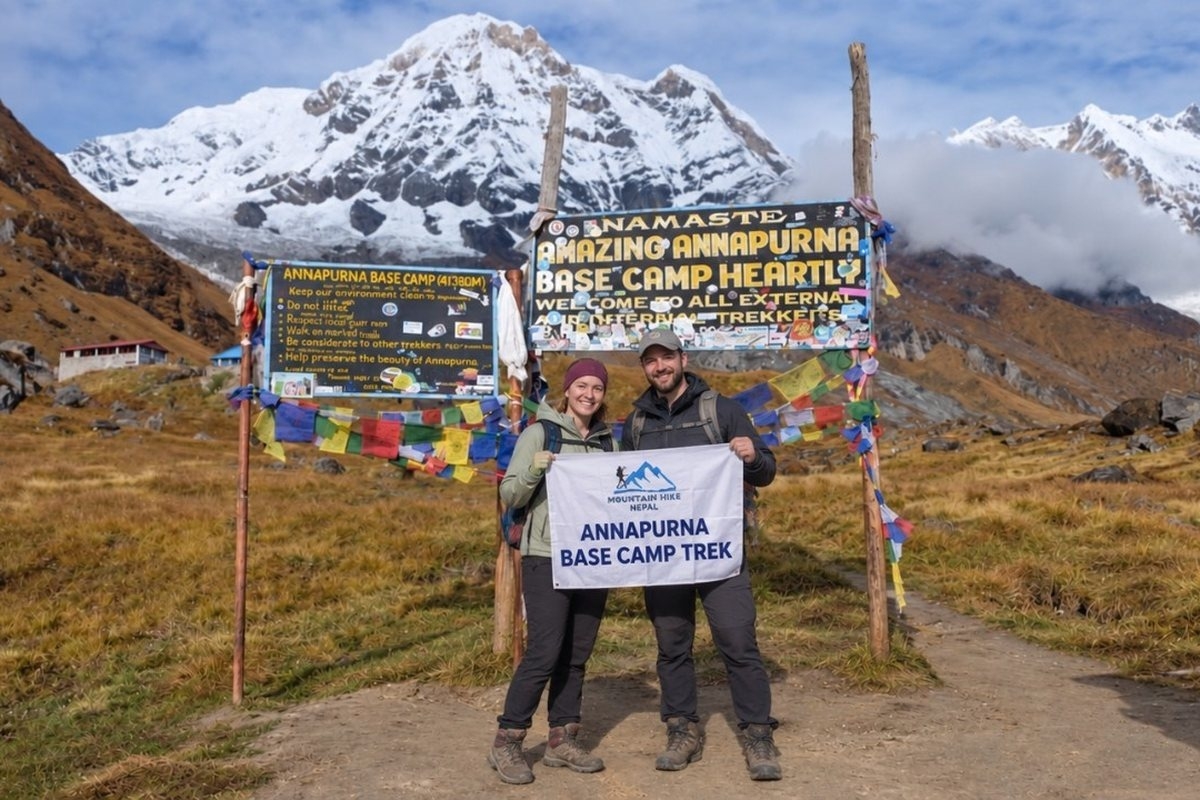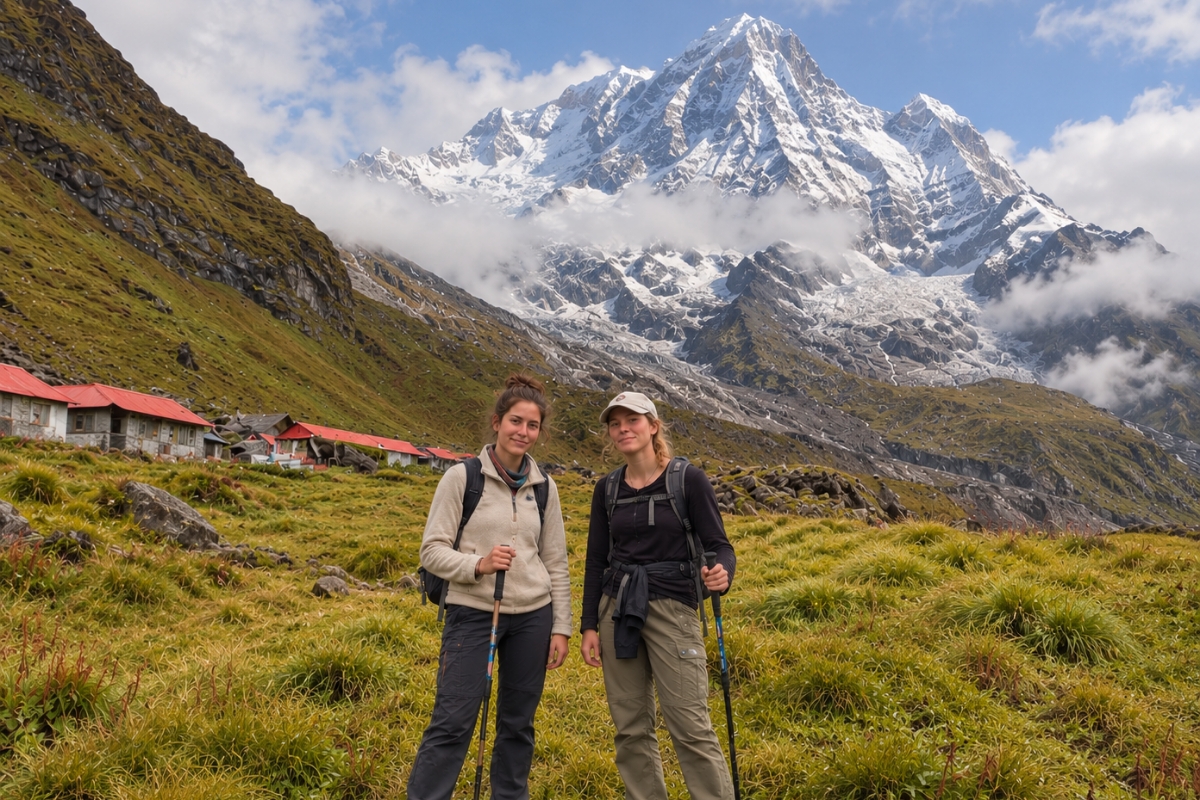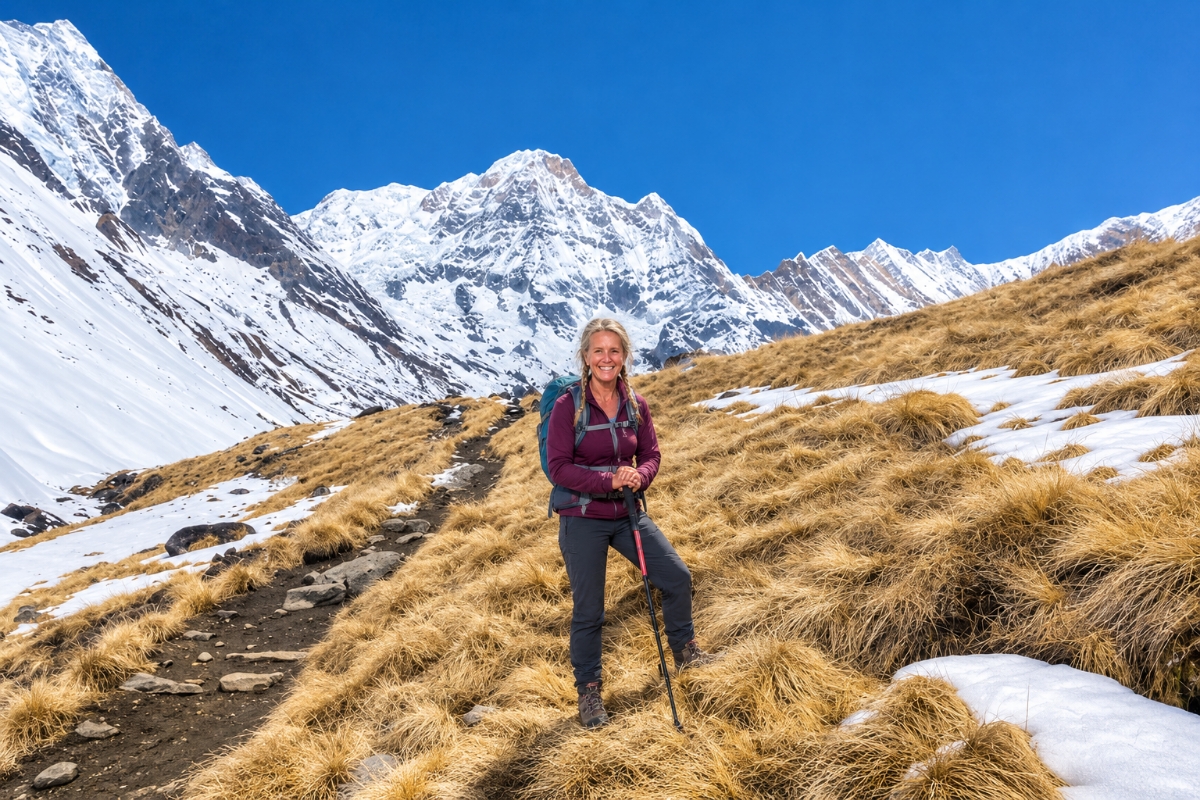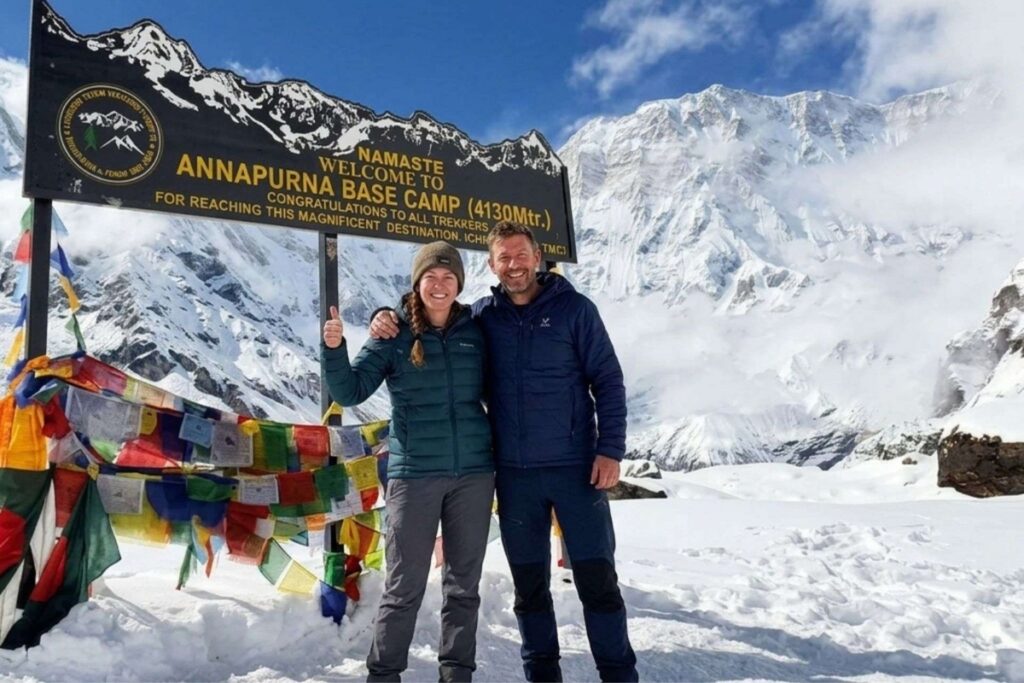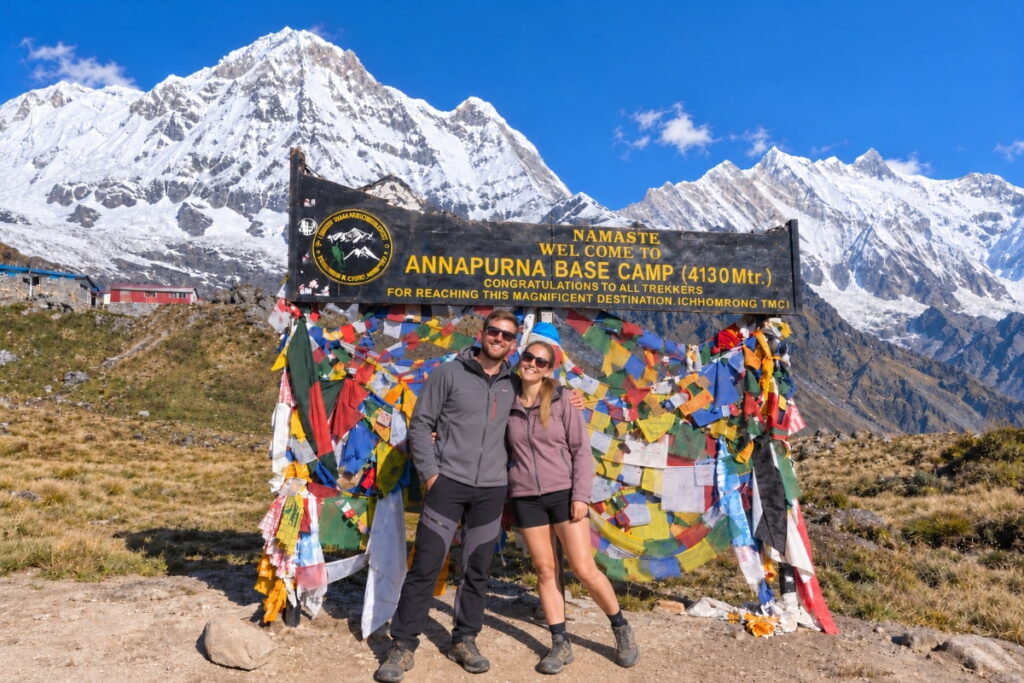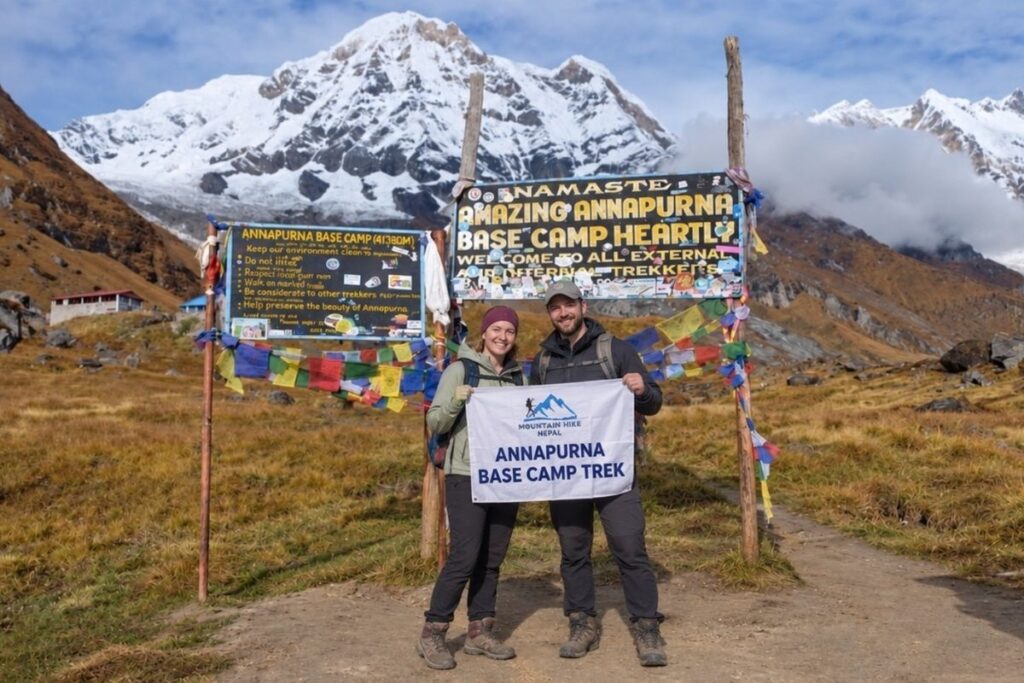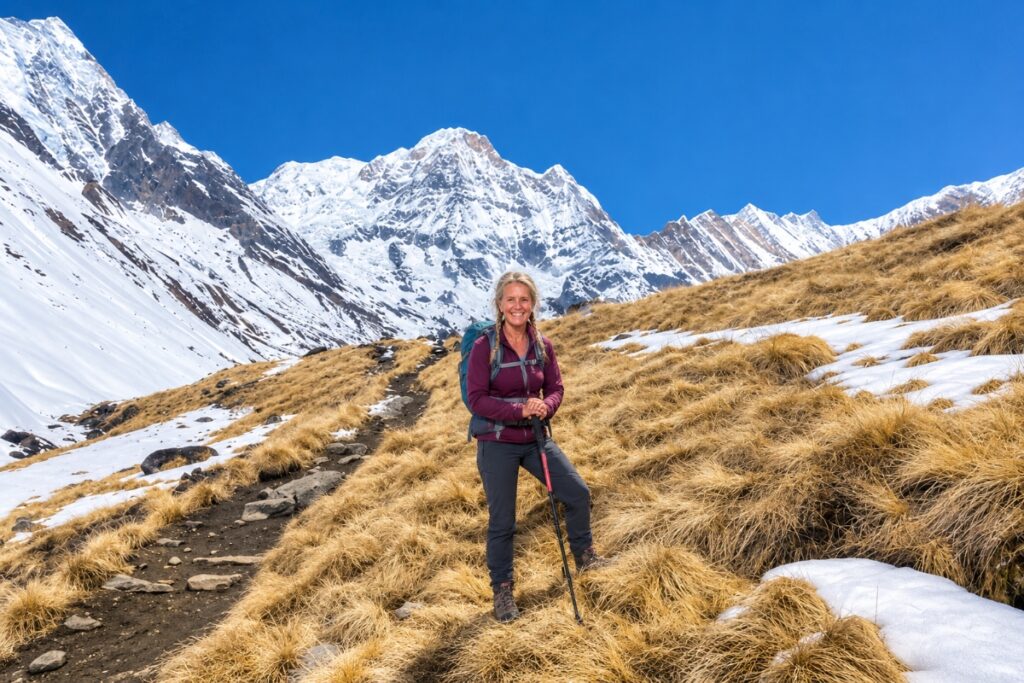
The Annapurna Base Camp Trek is a 10-day guided trek from Kathmandu to the Annapurna Sanctuary (4,130m). A larger group brings the per-person price down to $597; a solo booking runs $899. No technical climbing is required — no ropes, no crampons. Just steady daily walking and gradual altitude gain get you there.
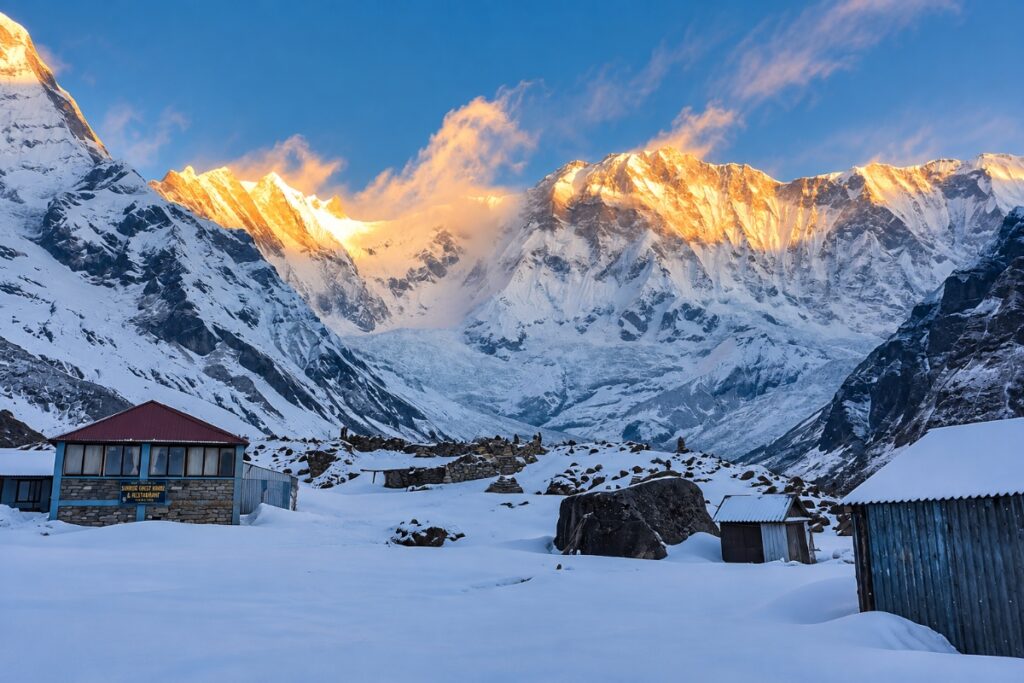
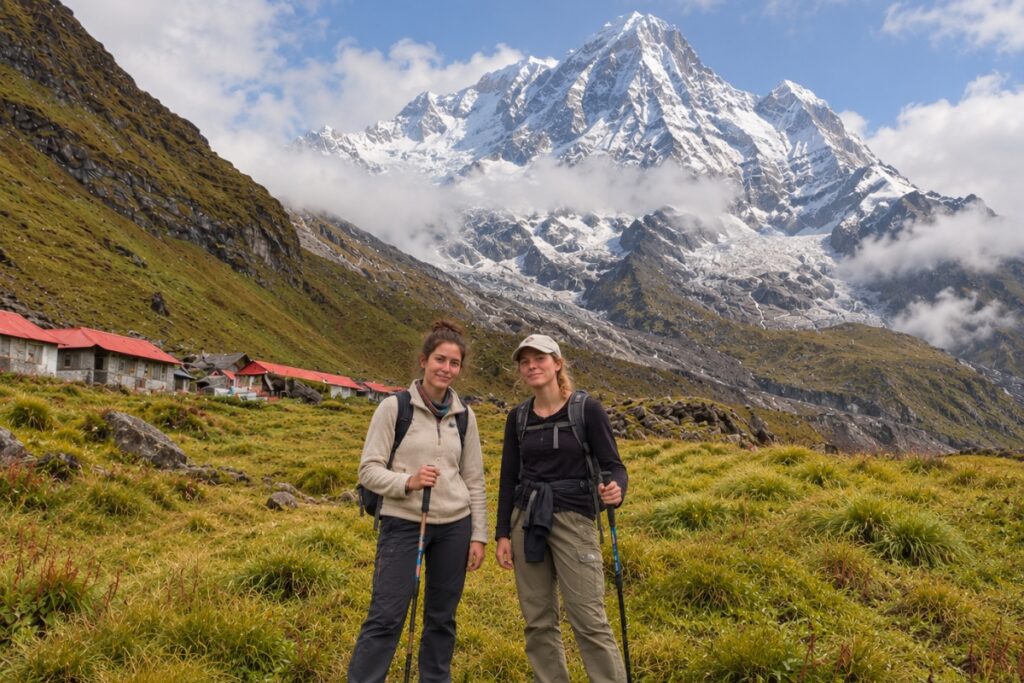
The Sanctuary itself is a glacial amphitheatre ringed by seven peaks above 6,000 metres. Annapurna I (8,091m), Machapuchare (6,993m), Hiunchuli, and Gangapurna close in on every side. Most Himalayan treks leave you looking up at the mountains from below; this one puts you inside them.
Four days of road travel connect Kathmandu, Pokhara, Ghandruk, and Jhinu Danda. The remaining six days cover the trekking on foot through the Modi Khola gorge. No domestic flight or technical skill is needed for this route. The real preparation is steady daily walking and following your guide’s pace — most days run 5 to 6 hours. Want the sunrise viewpoint added? Customise your itinerary to route via Ghorepani and Poon Hill.
We’re a Kathmandu-based trekking company, and a licensed guide is legally required on this route. Every departure includes one, along with porter support and all permits arranged before you land. Message us on WhatsApp with your travel dates and group size.
| Trip Details | Information |
|---|---|
| Trek Name | Annapurna Base Camp Trek |
| Total Duration | 10 Days (Kathmandu to Kathmandu) |
| Road Travel Days | 4 days — Kathmandu ↔ Pokhara ↔ Ghandruk ↔ Jhinu Danda |
| Trekking Days | 6 days |
| Maximum Altitude | 4,130m — Annapurna Base Camp |
| Major Highlights | Annapurna Sanctuary, Machapuchare Base Camp, Ghandruk, Chhomrong, Jhinu Hot Springs |
| Trek Difficulty | Moderate |
| Trek Start / End | Ghandruk (from Pokhara) / Jhinu Danda (to Pokhara) |
| Best Season | Spring (March–May) and Autumn (September–November) |
| Good Off-Season | Winter — cold nights, clear views, very few trekkers |
| Avoid | Monsoon — June, July, August |
| Accommodation | Hotel in Pokhara / Teahouse on trail |
| Meals Included | Breakfast, Lunch and Dinner (trekking days) |
| Permits Required | ACAP + TIMS |
| Region | Annapurna Conservation Area, Nepal |
Kathmandu → Pokhara → Ghandruk → Chhomrong → Bamboo → Deurali → Machapuchare Base Camp → Annapurna Base Camp → Bamboo → Jhinu Danda → Pokhara → Kathmandu
Most Himalayan base camp treks put you at the foot of one mountain, looking up. Annapurna Base Camp puts you inside a ring of them — Annapurna I, Machapuchare, Hiunchuli, and Gangapurna surrounding the Sanctuary on every side, all above 6,000 metres. Ten days is enough to reach that view and get back, without months of planning or a Lukla-style flight risk to worry about.
The route stays moderate compared to Everest Base Camp or the Annapurna Circuit — no altitude above 4,130 metres, so the physical and acclimatisation demands are lower while the mountain scenery stays genuinely world-class. Jhinu Danda’s natural hot springs at the end of the trek are a real, practical reward, not a marketing line — most trekkers actually use them after six days on the trail.
Comparing ABC to the longer Annapurna Circuit or the shorter Ghorepani Poon Hill trek? ABC sits between them — more remote and higher than Poon Hill, shorter and less demanding than the full Circuit. Customise your itinerary to add Poon Hill’s sunrise viewpoint if you want both in one trip.
The route is genuinely moderate, not easy. Days run 5 to 6 hours, some sections — particularly the stone-step climb above Ulleri if your itinerary passes through there — are steeper than the overall difficulty rating suggests. There’s no technical climbing and no altitude above 4,130 metres, so this sits well below EBC’s physical demand, but it still rewards real preparation. A few weeks of regular hill walking beforehand makes a genuine difference in how the daily climbs feel.
per person
per person
per person
per person
Altitude: 820m | Drive: 6–7 hrs (or 25 min flight) | Meals: Dinner | Stay: Hotel, Pokhara
The drive out of Kathmandu follows the Trishuli and Marsyangdi rivers west, through terraced hillsides and small roadside towns, before Pokhara opens up on the shore of Phewa Lake with the Annapurna range filling the horizon behind it. It’s a long day in the vehicle, but it’s also the first real look at where you’re headed — Machapuchare’s fishtail summit is visible from Pokhara on a clear evening, and it doesn’t leave your sightline again until you’re standing underneath it a week later. We keep this a travel day on purpose, so you land at the trailhead tomorrow rested, not road-worn.
Altitude: 1,940m | Drive: 3–4 hrs | Meals: Breakfast, Lunch, Dinner | Stay: Teahouse, Ghandruk
A scenic drive from Pokhara up to Ghandruk, following the road as it climbs through terraced hillsides and small villages before ending right at the doorstep of one of the best-preserved Gurung villages in Nepal. Arriving by road means more time to actually settle into Ghandruk on Day 2 rather than rushing in tired — stone houses, slate roofs, and Annapurna South and Hiunchuli rising directly above the village. Take the afternoon to walk through the village itself and visit the small Gurung heritage museum before the trekking starts properly tomorrow.
Altitude: 2,170m | Trek: 5–6 hrs | Meals: Breakfast, Lunch, Dinner | Stay: Teahouse, Chhomrong
The trail drops out of Ghandruk into a forested valley before climbing back up to Chhomrong — the last proper village before the Sanctuary itself. Chhomrong sits directly across the gorge from Annapurna South, close enough that the mountain feels like it’s leaning over the village. This is also the last stop with an ATM and a real choice of teahouse food, so it’s worth taking a slower afternoon here before the trail narrows into the gorge above.
Altitude: 2,310m | Trek: 5–6 hrs | Meals: Breakfast, Lunch, Dinner | Stay: Teahouse, Bamboo
A steep drop down stone steps out of Chhomrong, across the river, then a long climb through Sinuwa before the trail levels into the bamboo and rhododendron forest that gives this stop its name. The gorge closes in properly here — dense forest canopy, waterfalls cutting through the rock on both sides, and the Modi Khola running constantly below. It’s a genuinely beautiful stretch of trail, and a noticeably quieter, cooler day than the exposed ridgelines before it.
Altitude: 3,230m | Trek: 5–6 hrs | Ascent: +920m | Meals: Breakfast, Lunch, Dinner | Stay: Teahouse, Deurali
The forest thins out steadily through Dovan and Himalaya as the valley narrows and the walls close in on both sides. This is where the trek starts to feel like it’s entering the Sanctuary rather than just approaching it — avalanche chutes visible on the peaks above, the temperature dropping with every hour of elevation gained. Deurali sits right at the treeline, the last stop before the landscape turns to open alpine terrain.
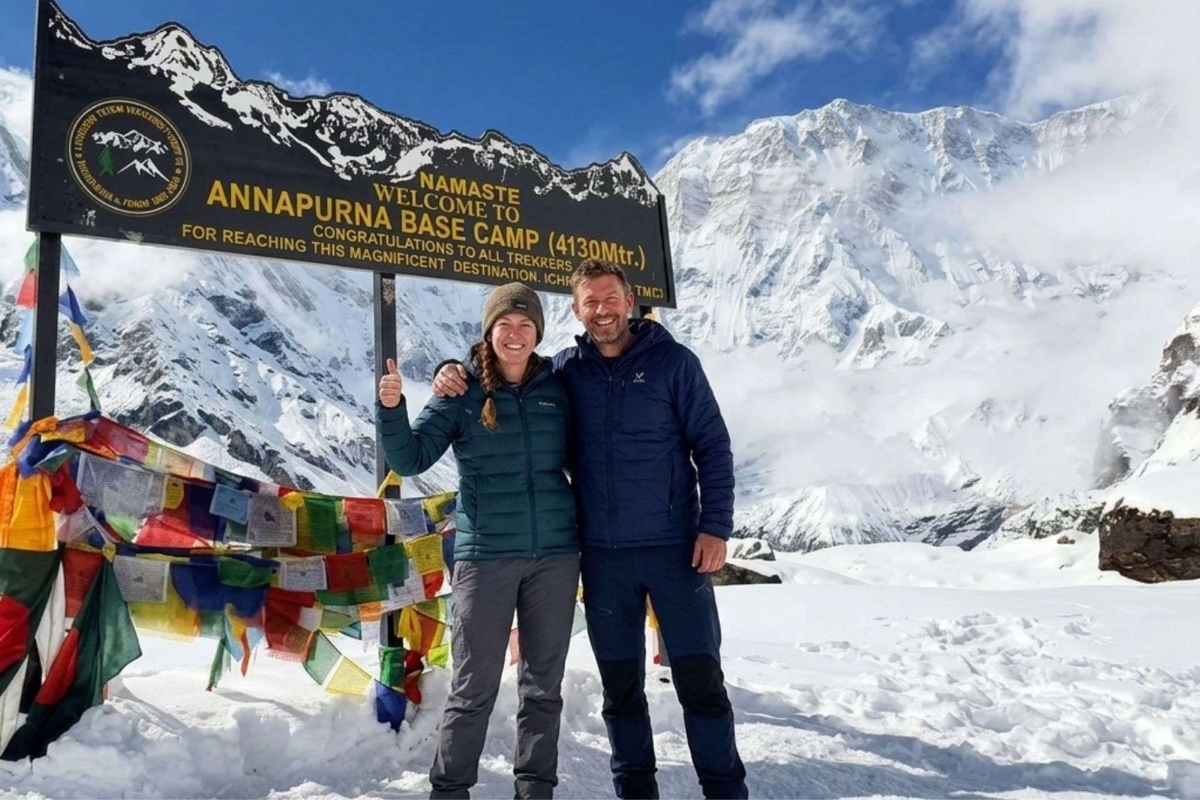
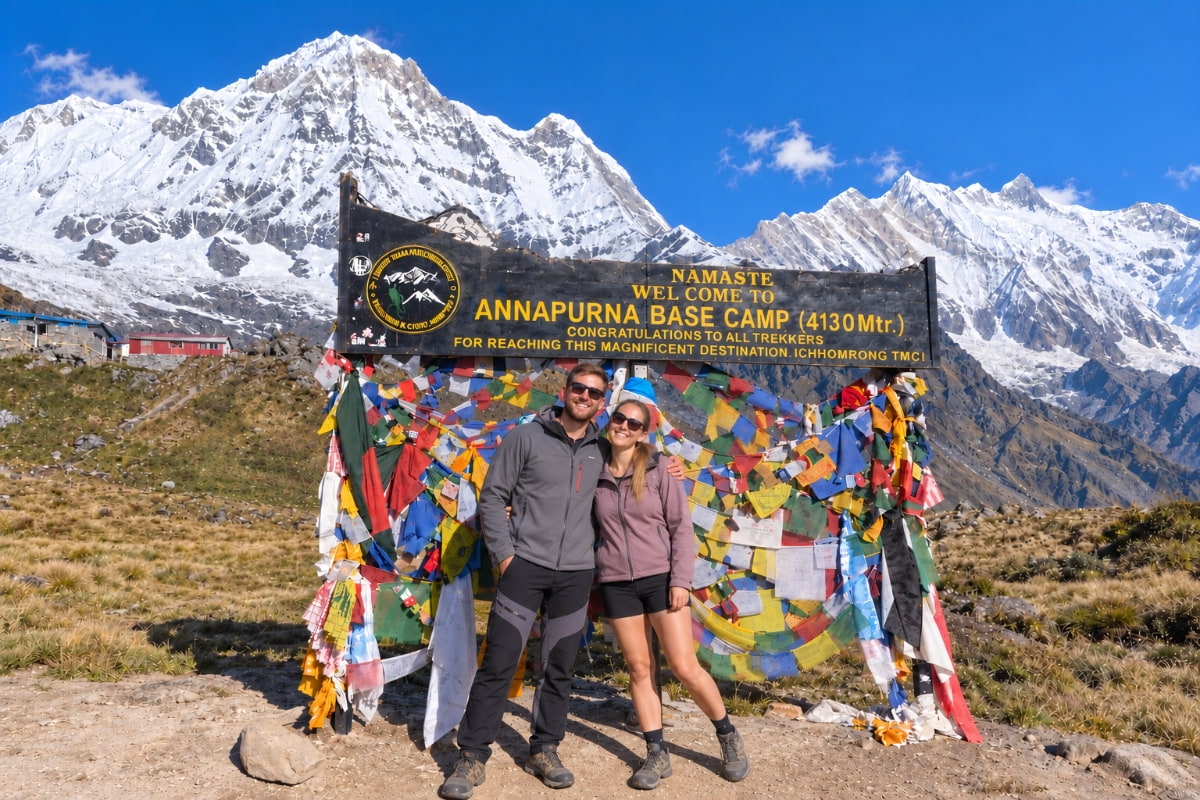
Altitude: 4,130m | Trek: 5–6 hrs | Ascent: +900m | Meals: Breakfast, Lunch, Dinner | Stay: Teahouse, Annapurna Base Camp
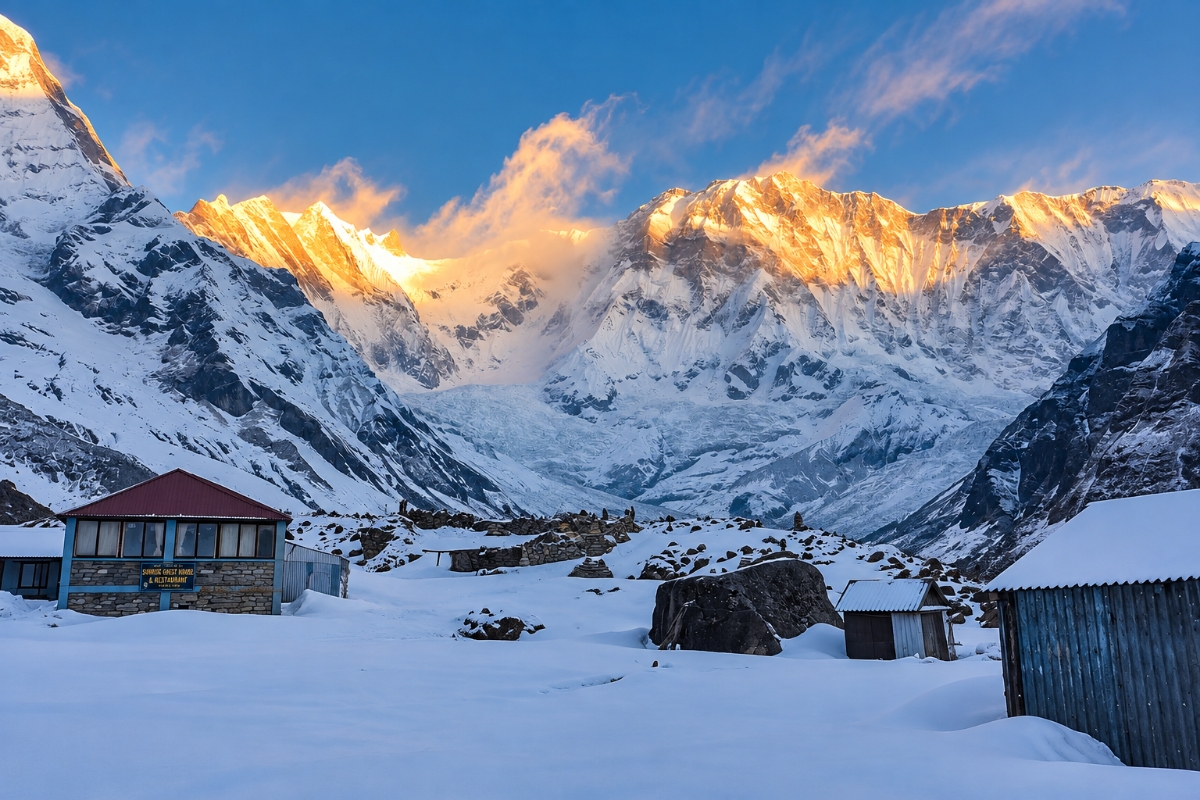
This is the day the whole trek has been building toward. The trail climbs out of the forest completely into open alpine ground, passing Machapuchare Base Camp (3,700m) — the sacred fishtail peak rising directly overhead, close enough that it no longer looks like a distant summit. From MBC the final push into the Sanctuary itself opens onto Annapurna Base Camp at 4,130m, completely enclosed by Annapurna I, Annapurna South, Hiunchuli, and Gangapurna on every side. Nothing else in Nepal delivers this specific feeling of being surrounded rather than looking up from below.
Altitude: 2,310m | Trek: 6–7 hrs | Meals: Breakfast, Lunch, Dinner | Stay: Teahouse, Bamboo
An early start for sunrise at Base Camp — Annapurna South and Hiunchuli catching the first light, then Machapuchare turning gold as the sun clears the ridgeline. After that, the long descent begins, retracing yesterday’s route back down through Deurali and Himalaya to Bamboo. The knees do the work today that the lungs did on the way up — the terrain is familiar, but going down through the gorge in daylight after climbing it feels like a completely different trail.
Altitude: 1,780m | Trek: 5–6 hrs | Meals: Breakfast, Lunch, Dinner | Stay: Teahouse, Jhinu Danda
The trail continues down through Sinuwa and Chhomrong, then branches toward Jhinu Danda — home to a set of natural hot springs right on the riverbank. After a week of teahouse showers and cold mornings, the springs are one of the most genuinely earned rewards on any Nepal trekking route. Most trekkers spend the evening soaking with a view of the gorge they just walked out of.
Altitude: 820m | Drive: 2.5–3 hrs | Meals: Breakfast, Lunch | Stay: Hotel, Pokhara
No trek today — the trip ends with a drive straight from Jhinu Danda back to Pokhara, with the road picking up close to the village. Hot showers, real beds, and lakeside restaurants after eight days on the trail — this arrival is usually the first proper rest of the whole trip, and it’s well earned.
Drive: 6–7 hrs (or 25 min flight) | Meals: Breakfast
The return drive to Kathmandu, retracing the route from Day 1 in reverse. Ten days, the full Annapurna Sanctuary, and a genuinely different mountain experience than anywhere else in Nepal. Done.
The Annapurna Base Camp Trek is a 10-day Himalayan journey from Kathmandu — four days of road travel and six days trekking through the Annapurna Conservation Area to the sanctuary at 4,130m. The sanctuary itself is a glacial amphitheatre completely enclosed by seven peaks above 6,000m, including Annapurna I — the tenth-highest mountain on earth. No technical climbing exists anywhere on the route. Just preparation, a steady pace, and one of the most extraordinary mountain environments on the planet.
The standard Mountain Hike Nepal itinerary is 10 days total from Kathmandu — Day 1 is the drive to Pokhara, Day 2 is a scenic drive directly to Ghandruk, Days 3 through 8 cover the trekking circuit from Ghandruk to the Sanctuary and back down to Jhinu Danda (6 full trekking days), Day 9 is the drive from Jhinu Danda back to Pokhara, and Day 10 is the return drive to Kathmandu. The Ghorepani and Poon Hill variation adds 2–3 extra trekking days for a total of 12–13 days. Contact us to build the extended itinerary into your booking from the start.
The trek is rated moderate — not casual, but absolutely achievable for well-prepared trekkers. The most demanding sections are the steep gorge terrain between Chhomrong and Deurali, the long 1,820m descent on Day 7, and sustained altitude above 3,200 metres from Day 5 onward. Six to eight weeks of consistent outdoor preparation before departure makes a real difference. The Poon Hill extension adds one extra demanding day but does not change the overall moderate rating significantly. For a full section-by-section breakdown: ABC Trek Difficulty Guide →
Two permits cover the full route — the Annapurna Conservation Area Permit (ACAP) at NPR 3,000 per person, and the TIMS card at NPR 1,000 per person when issued through a registered agency like ours (the NPR 2,000 rate applies only to independent trekkers applying without an agency). Unlike the Everest region, where TIMS was replaced by a local permit in 2018, TIMS remains required for Annapurna region treks including ABC. Mountain Hike Nepal includes both permits in every package price. Your guide handles all permit documentation and presents it at every checkpoint — no separate application or permit office visit from you at any point. For full details: ABC Permits Guide 2026 →
Yes — Nepal’s April 2023 trekking regulations require all foreign trekkers in the Annapurna region to use a licensed guide from a registered agency. Independent trekking without a guide is no longer legally permitted regardless of experience level or nationality. Mountain Hike Nepal includes licensed English-speaking guides with specific Annapurna region knowledge on every departure — this is a standard package inclusion, not an optional extra.
October and November are the finest months — post-monsoon clarity, stable weather, and the clearest mountain views of the year. April is the best spring option — rhododendron forests in full bloom between Ghandruk and Chhomrong, and the Annapurna range fully visible from base camp. December and early March are solid off-season choices for trekkers who want quieter trails. Avoid June, July, and August entirely — monsoon rain makes the gorge trail slippery and the mountains disappear under cloud for weeks. For the full month-by-month breakdown: Best Time for ABC Trek →
Yes — and if your schedule allows, take it. The classic Ghorepani–Poon Hill variation replaces the Ghandruk approach with a ridge route via Tikhedhunga, Ghorepani (2,860m), and Poon Hill (3,210m) before descending through Tadapani to Chhomrong. This adds 2–3 days and the finest sunrise panorama in the Annapurna region — Dhaulagiri, Annapurna South, and Machapuchare all visible simultaneously from the viewpoint tower at dawn. Both routes join at Chhomrong and reach the same Annapurna Sanctuary. Talk to us about the Poon Hill route →
The standard 10-day Kathmandu-to-Kathmandu package starts from USD 597 per person for groups of 8–12 and USD 899 for solo trekkers — guide, porter, all permits, all trek meals, teahouse accommodation, and all transport included. No domestic flight needed — every transfer runs by road between Kathmandu, Pokhara, and Ghandruk. The Poon Hill extension is priced separately by group size and additional days. For the full budget breakdown: ABC Trek Cost Guide → | Contact us for Poon Hill pricing →
Yes, though it isn’t part of the standard package, which travels overland by road. Buddha Air, Yeti Airlines, and Shree Airlines run multiple daily flights between Kathmandu and Pokhara — a 25 to 30 minute hop versus 6 to 9 hours by road. Message us on WhatsApp if you’d rather fly, and we’ll arrange it and quote it separately based on your dates and group size. Flying can save a travel day at either end, though a same-evening international connection right after the trek still leaves no buffer for delays.
Yes — we can arrange a helicopter return from the Annapurna region on request. Routing and pricing depend on group size, pickup point, and current availability, so message us directly to build this into your itinerary. Emergency medical evacuation by helicopter is also available from any point on the route; your travel insurance covers the cost when the policy explicitly includes trekking above 4,000m and helicopter evacuation.
Everything you need to plan the ABC trek in one place. Each guide covers a specific part of the journey in honest detail: