The Tibet Overland Tour from Nepal is an 8-day road journey from Kathmandu to Lhasa and back, following the same corridor traders and pilgrims used long before it became a tourist route.
You’ll cross the Rasuwagadhi border onto the Tibetan plateau at Kerung, pass Tingri with its views of Everest’s north face, Cho Oyu, and Shishapangma, then continue through Shigatse and Gyantse to Lhasa. On the way back, you’ll stop at Yamdrok Lake, one of Tibet’s three sacred lakes. No trekking or technical skill needed — this is a road trip, not a climb.
Because the altitude climbs steadily along the way, visa and permit planning matters just as much as packing right. Read our full Kathmandu to Lhasa Overland Tour guide → for the route, visa process, and real costs.
Planning a trek too? Our travel guide section covers Everest, Annapurna, Langtang, and Tibet side by side.
| Trip Details | Information |
|---|---|
| Trip Name | Tibet Overland Tour from Nepal |
| Duration | 7 Nights / 8 Days |
| Route Type | Full overland round trip via Kerung border |
| Maximum Altitude | 5,220m — Gyatchu La Pass |
| Major Highlights | Lhasa (Potala Palace, Jokhang Temple), Yamdrok Lake, Shigatse, Gyantse, Everest north-side views from Tingri |
| Trip Difficulty | Easy to Moderate — high-altitude road travel, no trekking |
| Trip Start / End Point | Kathmandu |
| Best Season | April to November |
| Not Recommended | December to March — snow risk on the high pass |
| Accommodation | Hotel (standard, with upgrade options available) |
| Meals Included | Breakfast daily |
| Group Departures | Every Saturday |
| Booking Window | At least 30 days in advance |
| Region | Kathmandu, Nepal → Lhasa, Tibet |
Kathmandu → Kerung (Gyirong) Border → Tingri/Lhatse → Shigatse → Lhasa → Gyantse (via Yamdrok Lake) → Xegar → Tingri → Kerung Border → Kathmandu
Most ways into Tibet get you there. This one prepares you for it.
Flying directly into Lhasa means your body absorbs a 2,300m altitude jump in under 90 minutes. The overland route spreads that same gain across three full days, crossing Gyatchu La — one of the highest road passes on earth at 5,220m — in daylight, with real time to adjust before you reach Lhasa’s monasteries and markets.
Furthermore, the route itself is most of the experience. You pass through the Gyirong Valley, often described by guides as one of the most beautiful valleys on the entire corridor, and Tingri, where Everest’s north face, Cho Oyu, and Shishapangma are all visible from the road on a clear day. Consequently, by the time you reach the Potala Palace, Tibet already feels familiar rather than sudden — the transition has been cultural and gradual, not a jolt from an airport.
Want to see the trekking side of the same Everest massif? Read our comparison: Everest Base Camp Trek vs the Tibet north-side road views →
This is not a physically demanding trip — there’s no trekking involved. The real preparation is logistical: the visa and permit process needs a full 30 days, so plan your Kathmandu arrival around that window rather than around the road journey itself. For the complete visa, permit, and day-by-day breakdown, read our Kathmandu to Lhasa Overland Tour guide →
✅ Private vehicle transport, Kathmandu to Lhasa and return, via the Kerung border both ways
✅ China Group Tourist Visa processing and Tibet Travel Permit — fully arranged from Kathmandu
✅ Twin-sharing hotel accommodation throughout, Kathmandu to Kathmandu
✅ Breakfast daily
✅ Experienced English-speaking guide for the full journey
✅ All monastery and sightseeing entrance fees as per the itinerary
✅ All applicable government taxes and service charges
❌ International airfare to and from Nepal
❌ Any flight ticket taken instead of completing the overland return leg — self-paid, and the package cost is not refunded for any unused portion
❌ Nepal entry visa — USD 50 for 30 days, on arrival at Tribhuvan International Airport
❌ Lunch and dinner throughout the trip
❌ Travel and medical insurance
❌ Hotel upgrade or single room supplement, if requested
❌ Personal expenses, tips for guide and driver, drinks, and souvenirs
❌ Any costs from weather delays, road closures, or circumstances beyond our control
Altitude: 1,300m → approx. 2,700m | Distance: 145km | Drive: 6–7 hrs | Meals: No | Stay: Hotel
The drive out of Kathmandu starts early, and the city thins out fast — traffic gives way to terraced hillsides, then to river valleys carved by the Trishuli and Bhote Koshi. Villages pass one after another, each one a little higher and a little quieter than the last. By the time the road reaches Rasuwagadhi, you’ve already climbed well over a kilometre without noticing it happen. Immigration and customs take a bit of patience — stamps, checks, a short walk across the bridge — and then you’re standing in Tibet. Furthermore, the pace today is deliberately unhurried. Your body has already started climbing, and the first night in Kerung is where that adjustment quietly begins.
Altitude: Tingri 4,300m / Lhatse 4,350m → Shigatse 3,900m | Meals: Breakfast | Stay: Hotel
This is the day the landscape changes completely. The forested valleys of yesterday disappear, replaced by wide, treeless plateau stretching to the horizon in every direction. Snow peaks sit distant and constant along the skyline. Near Tingri, on a clear morning, Everest’s north face appears — along with Cho Oyu and Shishapangma, three 8,000m giants visible without leaving your seat. Consequently, this single drive says more about Tibet’s scale than any photograph could. The road eases down into Shigatse by evening, Tibet’s second city, and the altitude gain today has been gradual enough that most people feel completely fine.
Altitude: 3,650m | Distance: 260km | Drive: 5–6 hrs | Meals: Breakfast | Stay: Hotel
The road east from Shigatse follows old trade routes along the river, and the plateau starts to feel more lived-in — more villages, more prayer flags strung across rooftops, more signs that you’re nearing somewhere significant. Furthermore, the first glimpse of Lhasa in the distance, often with the Potala Palace catching the afternoon light, is a moment worth staying awake for. Most groups roll into the city by late afternoon, with just enough daylight left to walk the block around your hotel and let it sink in — you’re actually here.
Altitude: 3,650m | Meals: Breakfast | Stay: Hotel
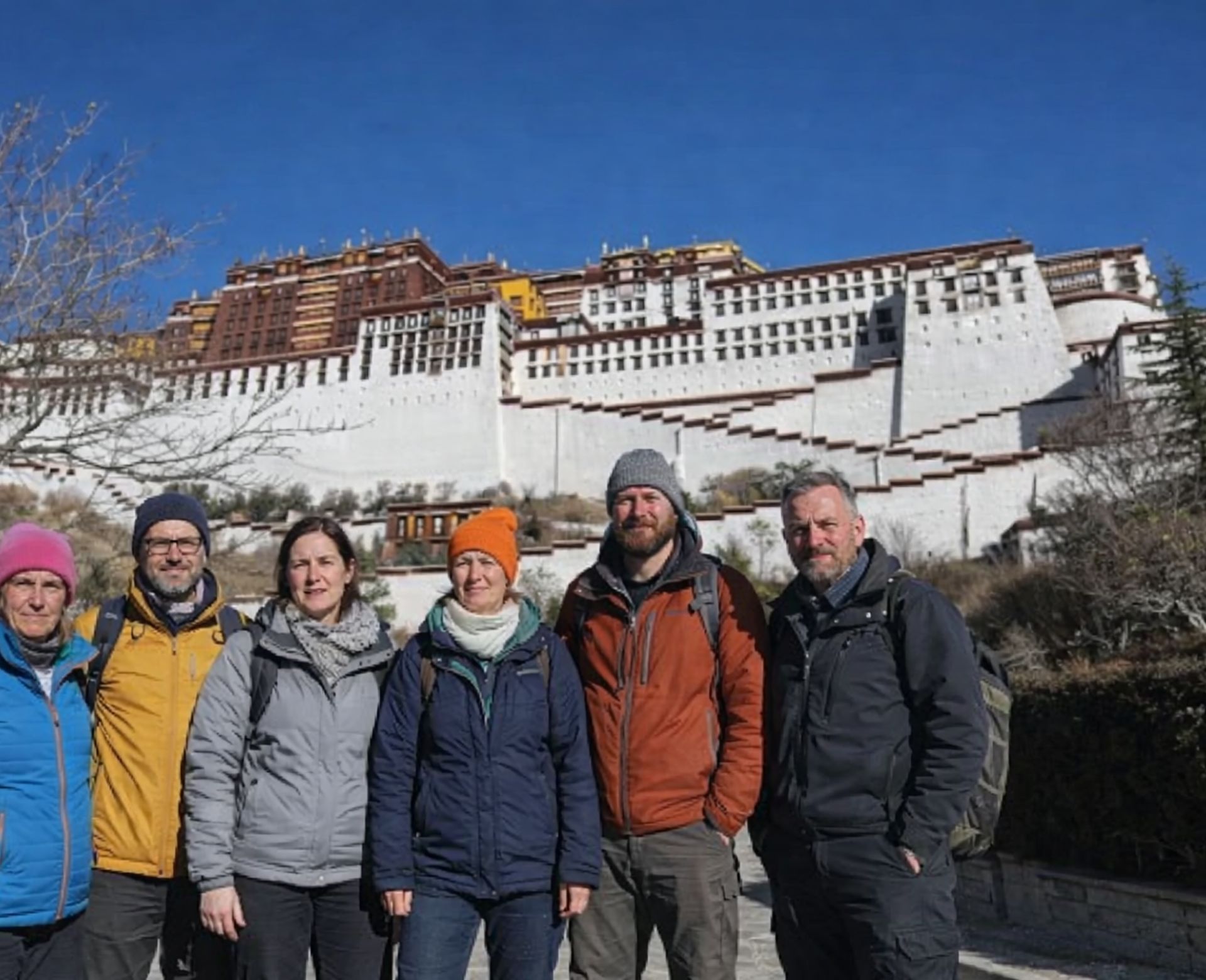
Today starts at the Potala Palace, and no photo prepares you for standing beneath it. Room after room of history, from the Dalai Lama’s former quarters to centuries-old murals still holding their colour. From there, the pace slows down at Jokhang Temple, where pilgrims prostrate themselves on the stone outside — some who’ve walked for weeks to get there. Furthermore, everything today is done on foot at an easy pace, which suits the altitude just fine.
Altitude: 3,650m | Meals: Breakfast | Stay: Hotel
Your second day in the city goes deeper — Sera or Drepung Monastery, where monks still hold their famous courtyard debates most afternoons, hands clapping to punctuate each argument. Later, Barkhor Bazaar pulls you into its stalls of prayer beads, yak wool, and silver jewellery, all circling the Jokhang in the same clockwise route pilgrims have walked for generations. Consequently, by the end of today, Lhasa stops feeling like a place you’re visiting and starts feeling like somewhere you’ve actually spent time.
Distance: 261km | Meals: Breakfast | Stay: Hotel
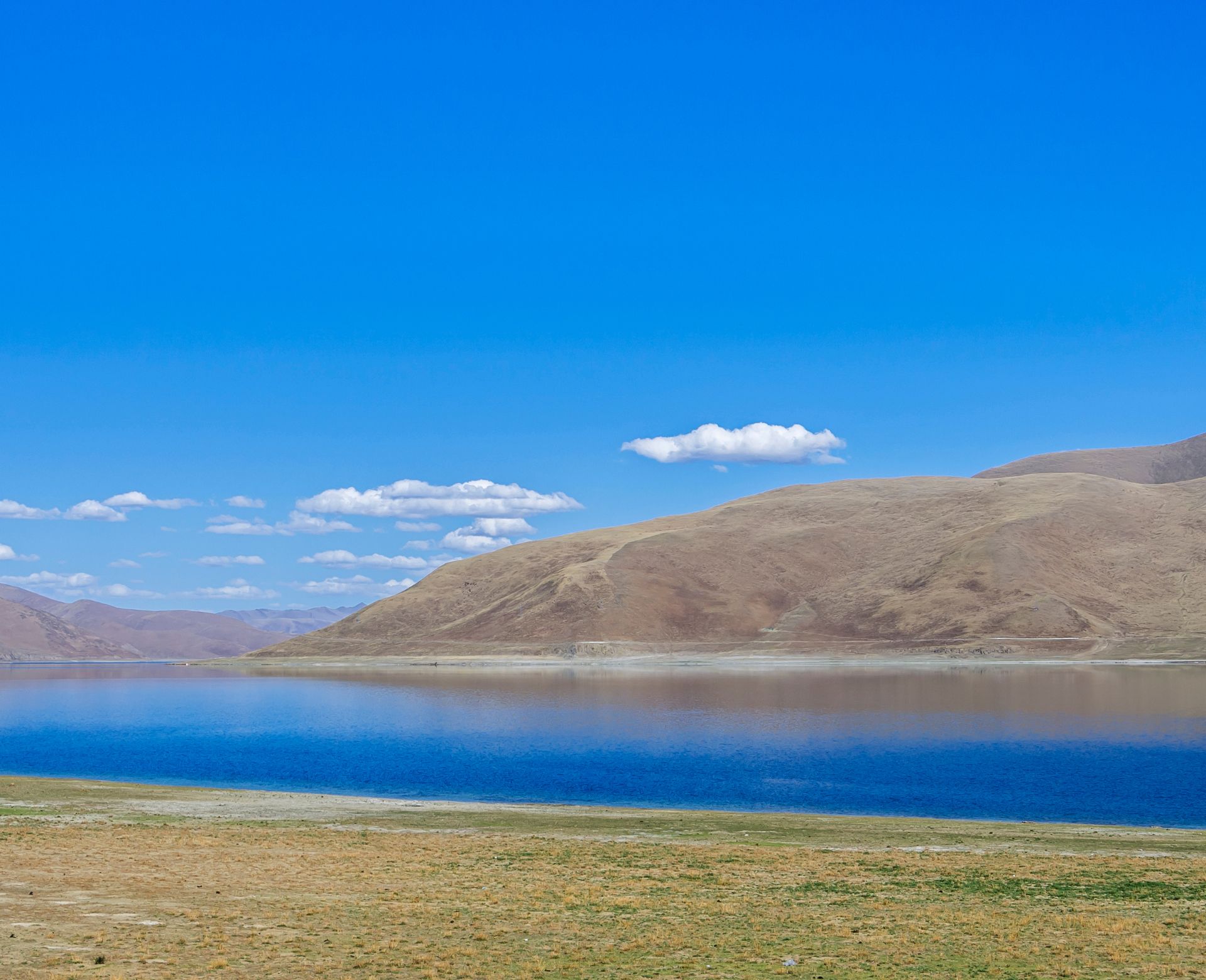
Leaving Lhasa, the road climbs into mountain passes, and then — without much warning — Yamdrok Lake appears below. It’s a colour that doesn’t quite look real, a deep turquoise stretched between mountains, and every driver on this route knows exactly where to pull over for it. Furthermore, this lake is sacred to Tibetan Buddhists, and standing at the viewpoint, it’s easy to understand why. The drive continues on to Gyantse by evening, a smaller, quieter town after two busy days in the capital.
Altitude: approx. 4,300m | Meals: Breakfast | Stay: Hotel
The return route heads west through Xegar, and the crowds of Lhasa feel a long way behind now. This is Tibet at its most open — long stretches with barely another vehicle in sight, just plateau, sky, and the occasional herd of yaks. Furthermore, this is also your last real look at the Himalayan skyline before the road starts bending back toward Nepal. Tingri for the night, cold and quiet, with stars that feel unusually close.
Drive: Full day | Meals: Breakfast
The last day retraces familiar ground back to the Kerung border. Exit formalities go quickly this time — you’ve done it before — and then the descent begins, back down through the valleys, back into thicker air, back into Kathmandu’s noise and colour. Consequently, eight days after you left, the trip closes the loop it opened — Lhasa, the plateau, Yamdrok’s turquoise water, all of it now firmly part of the story you’ll be telling for a long time.
Everything you need to plan this journey in one place, covering the details that actually matter before you book:
The standard itinerary is 8 days, 7 nights — a full overland round trip via the Kerung border, with two full days in Lhasa and the return route passing through Gyantse, Yamdrok Lake, and Xegar. Group departures run every Saturday.
Yes — a China Group Tourist Visa, issued only by the Chinese Embassy in Kathmandu through us as your licensed local agency. A standard Chinese tourist visa obtained in your home country is not valid for entry via Nepal. We handle the full application on your behalf.
Book at least 30 days before departure. The Tibet Travel Permit alone takes approximately 3 weeks of working-day processing time, and group departures run on a fixed Saturday schedule — booking later risks missing your intended departure entirely.
Our standard package is a full overland round trip, and the cost of the trip is built around that. That said, you’re not locked in — if you’d rather fly home, fly onward to mainland China, or your next holiday destination instead of finishing the overland leg, that’s entirely up to you. You can plan this in advance or decide at the last minute. Just note that any flight ticket to anywhere is not part of the package and is self-paid, and the package cost is not refunded for any portion of the overland journey you choose not to take.
Yes. The standard itinerary hotels are already good quality at no extra cost, but you can upgrade to a 4-star or 5-star hotel in Lhasa, Shigatse, or Gyantse for an add-on price, or book a single room instead of twin-sharing on either plan. Let us know what you’d like when you enquire, and we’ll build it into your booking.
No — this is a road journey, not a trek. There’s no walking involved beyond normal sightseeing on foot in Lhasa and at monastery stops. Altitude is the main factor to prepare for, and the overland route itself is designed to manage that gradually, rather than throwing your body into it all at once.
The Rasuwagadhi–Kerung (Gyirong) crossing — the functioning route between Nepal and Tibet since the 2015 earthquake damaged the older Zhangmu/Kodari border. It remains the standard crossing used by every licensed overland operator today.
April through November. Outside this window, snow and ice risk on the high pass around Gyatchu La makes the crossing unreliable, and most operators don’t run departures December through March. October in particular tends to offer the clearest, most stable weather on both sides of the border.
Yes — many travelers pair this tour with Everest Base Camp, Annapurna, or Langtang treks in the same trip, since the best trekking and overland seasons largely overlap. Contact us and we can help sequence both trips around your available time in Nepal.
The standard 8-day package runs USD 1,200–1,500 per person for a group of 2–4, covering your private vehicle, guide, permits, twin-share hotel accommodation, and breakfast daily. Visa fees are separate and vary by nationality. Furthermore, no international flight cost applies to the standard package, since the full journey runs by road in both directions.
Warm layers are essential, even outside winter — nights at Tingri and Lhatse sit above 4,300m and can drop close to freezing. Bring sunglasses and