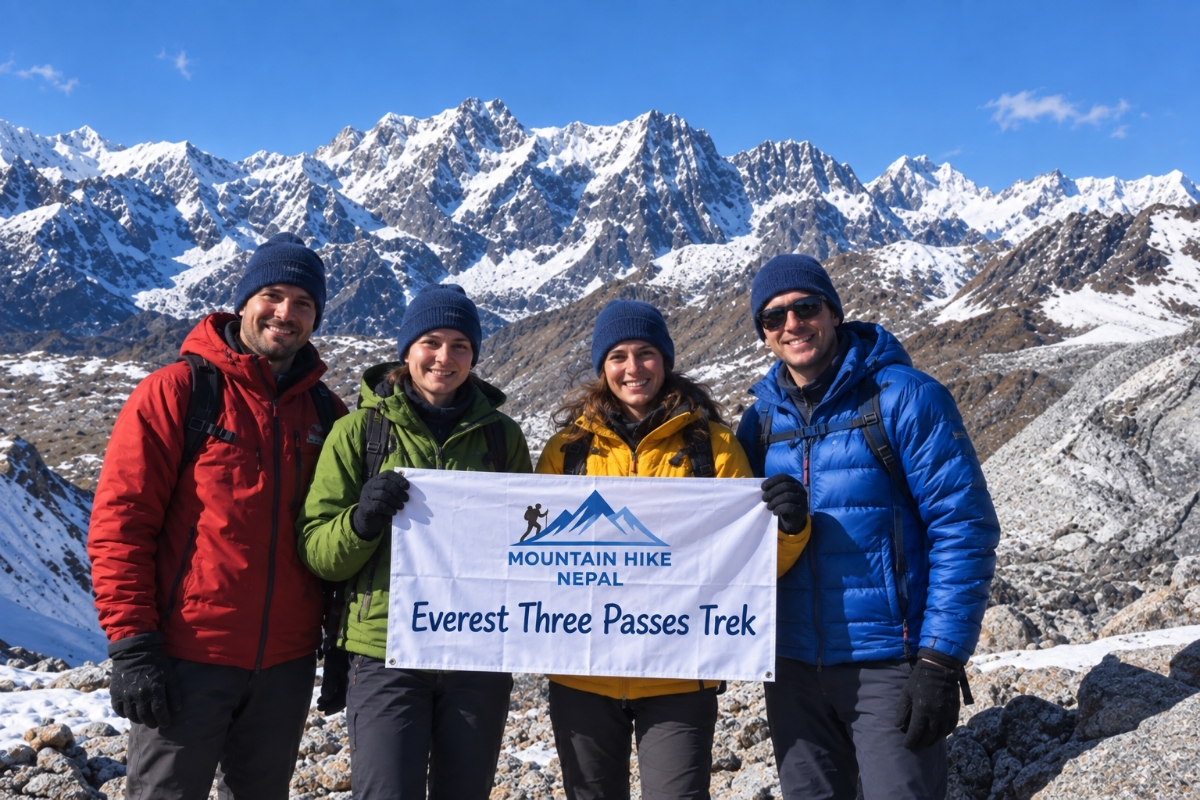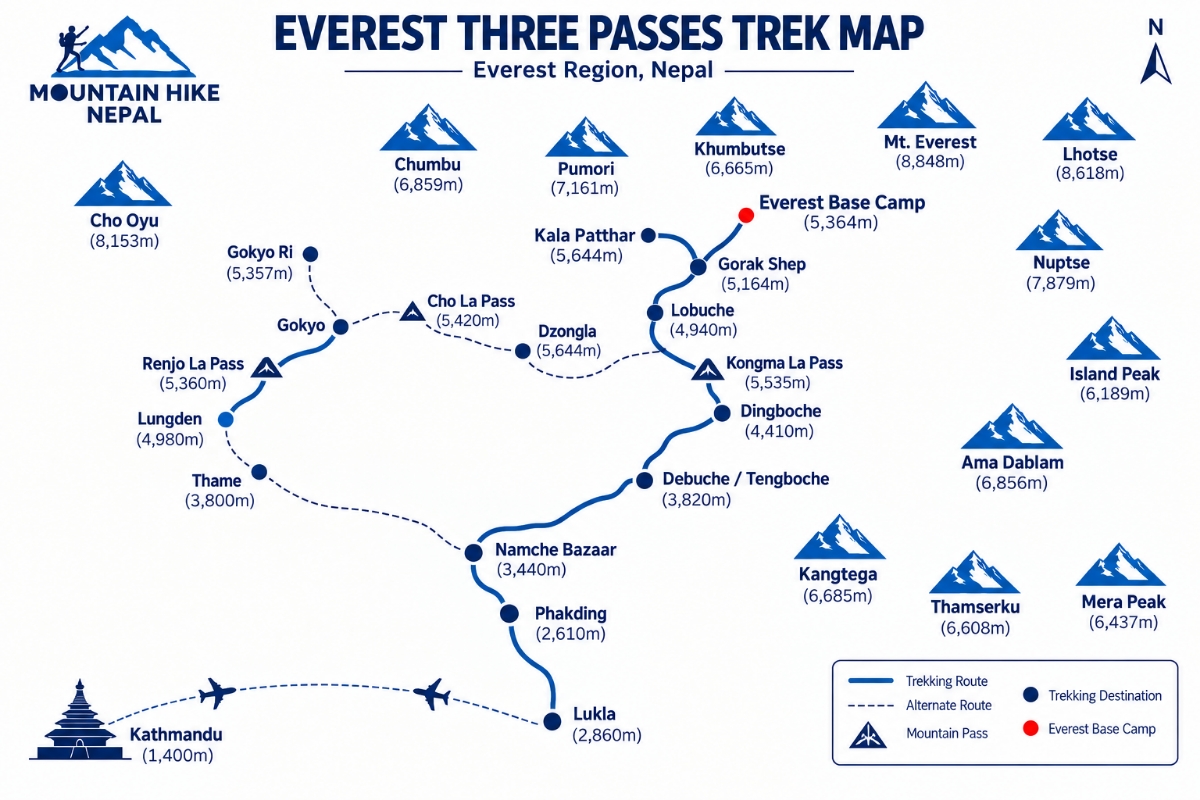
The Everest Three Passes Trek is a 16-day guided circuit through the Khumbu, priced from $1,499 to $1,899 per person. It crosses Kongma La (5,535m), Cho La (5,420m) and Renjo La (5,360m). Along the way it reaches Everest Base Camp and Gokyo Ri (5,357m).
This is a walking route, not a climb. Cho La is the one exception, with a short glacier crossing where microspikes are often needed. Each pass is above 5,300m, and pass days are long.
It is not a first Himalayan trek. Read our guide to acclimatisation in Nepal trekking or see how it compares in our Three Passes vs EBC guide.
Not ready for this circuit? Start with our Everest Base Camp Trek, or check the cost breakdown. When you know your travel month, message us on WhatsApp. We typically reply within 12 hours.
| Trip Details | Information |
|---|---|
| Trip Name | Everest Three Passes Trek in Nepal |
| Duration | 15 Nights / 16 Days |
| Maximum Altitude | 5,644m — Kala Patthar |
| Major Highlights | Kongma La (5,535m), Cho La (5,420m), Renjo La (5,360m), Everest Base Camp (5,364m), Kala Patthar (5,644m), Gokyo Lakes, Gokyo Ri (5,357m) |
| Trek Difficulty | Challenging — High Altitude Trek with Three Technical Passes |
| Trek Start / End Point | Lukla |
| Best Season | Spring (March–May) and Autumn (September–November) |
| Low Season | Winter — cold, clear, passes require more care |
| Not Recommended | Monsoon Season (June–August) |
| Accommodation | Teahouse Lodges |
| Meals Included | Breakfast, Lunch and Dinner |
| Trek Style | Guided High-Altitude Trekking with Technical Pass Crossings |
| Region | Everest (Khumbu), Nepal |
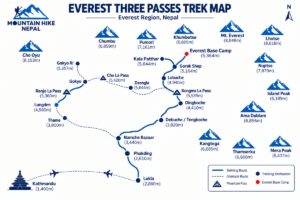
Lukla → Phakding → Namche Bazaar → Tengboche → Dingboche → Kongma La (5,535m) → Lobuche → Gorakshep → Everest Base Camp (5,364m) → Kala Patthar (5,644m) → Dzongla → Cho La (5,420m) → Gokyo → Gokyo Ri (5,357m) → Renjo La (5,360m) → Thame → Namche Bazaar → Lukla
The standard EBC Trek takes you to Base Camp and back on the same trail. The Everest Three Passes Trek circles the entire Khumbu massif instead, crossing three high passes that connect valleys most trekkers never see.
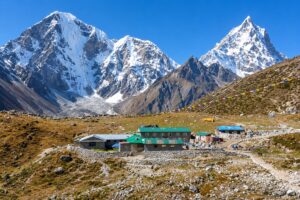
The Khumbu from Kongma La looks nothing like the Khumbu from Renjo La. The Gokyo Valley, reached from Cho La, is one of Nepal’s finest high-altitude valleys. It has six sacred turquoise lakes, Nepal’s longest glacier below Gokyo Ri, and far fewer trekkers than the main EBC trail above Tengboche. This circuit shows a side of the Khumbu the standard route doesn’t reach.
The acclimatisation structure is also one of the most thorough on a standard Nepal trek. Altitude builds gradually across three valleys over 15 nights, with the final Renjo La crossing coming last, on the descent. Trekkers finish having covered far more of the Khumbu than the standard EBC trail allows.
For trekkers considering options in the Khumbu, read our Everest Three Passes Trek vs EBC comparison →
This trek is challenging, significantly more demanding than the standard EBC route. The three pass crossings require specific fitness preparation and good balance on rocky, occasionally snowy terrain. Pass days also mean moving in cold, pre-dawn conditions. We recommend 8–10 weeks of dedicated uphill walking preparation before this expedition. For the complete difficulty assessment read: Everest Three Passes Trek difficulty guide →
Peak Season (Spring: March–May | Autumn: September–November): Lukla flights operate from Manthali Airport in Ramechhap during these busiest months, not Kathmandu. Expect an early-morning 4–5-hour overland drive from Kathmandu to Ramechhap before the short flight to Lukla.
Off-Peak Season (Winter: December–February | Monsoon: June–August): Lukla flights generally operate directly between Kathmandu and Lukla in these months, subject to airline schedules and weather.
The Civil Aviation Authority of Nepal (CAAN) runs this seasonal arrangement to reduce congestion at Tribhuvan International Airport during peak season. It applies to every airline flying scheduled Lukla routes, including Tara Air, Summit Air, and Sita Air. We include the Ramechhap transfer in every package for this reason.
Prefer to skip a flight leg entirely? A helicopter upgrade is available on request. A shared seat currently runs roughly $650–700 per person one way. Heli pricing moves with fuel costs and passenger numbers, so treat this as a current rate, not a locked-in figure. We can also arrange a return pickup from Gorakshep, Dingboche, or Namche instead of walking back to Lukla. See our full FAQ on Lukla flight alternatives for the breakdown.
per person
Recommended
per person
per person
Value Added
per person
Altitude: 2,610m | Flight: 35 min | Trek: 3–4 hrs | Meals: Lunch, Dinner | Stay: Teahouse, Phakding
The flight into Lukla is short but earns its reputation — a cliff-edge runway, mountains close on both sides. From there the trail drops through pine forest and Sherpa settlements along the Dudh Koshi River to Phakding. Sixteen days and three passes start with the easiest walking day of the trip.
Altitude: 3,440m | Trek: 5–6 hrs | Ascent: +638m | Meals: Breakfast, Lunch, Dinner | Stay: Teahouse, Namche Bazaar
The trail crosses the Dudh Koshi on a string of suspension bridges, enters Sagarmatha National Park at Jorsale, and climbs steeply into Namche — the Sherpa capital, and the town you’ll return to twice more before this circuit ends.
Altitude: 3,440m overnight / 3,880m hike | Hike: 3–4 hrs | Meals: Breakfast, Lunch, Dinner | Stay: Teahouse, Namche Bazaar
A hike up to the Everest View Hotel ridge, then back down to Namche. Not optional — this is the first of four dedicated acclimatisation points on the circuit, and every one of them matters before the passes start.
Altitude: 3,820m | Trek: 5–6 hrs | Meals: Breakfast, Lunch, Dinner | Stay: Teahouse, Debuche
The trail climbs through rhododendron forest to Tengboche, the most atmospheric monastery in the Khumbu — Ama Dablam on one side, Everest on the other. We drop through forest to Debuche for the night.
Altitude: 4,410m | Trek: 5–6 hrs | Ascent: +590m | Meals: Breakfast, Lunch, Dinner | Stay: Teahouse, Dingboche
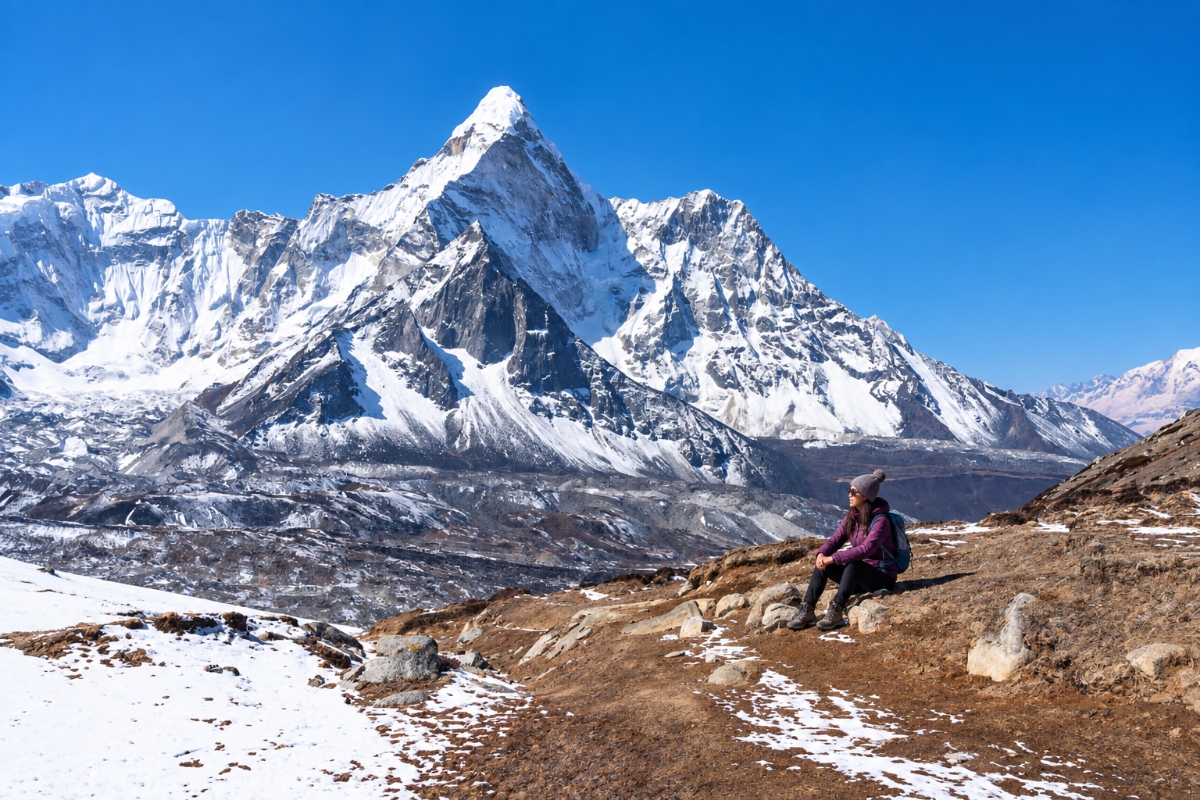
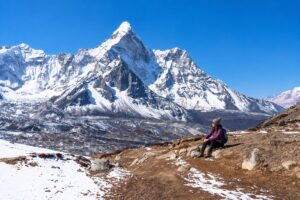
Past Pangboche the trees thin and the alpine terrain begins. Dingboche opens into a wide valley with Ama Dablam, Lhotse and Island Peak on the horizon — the staging point for the first pass.
Altitude: 5,000m hike / 4,410m overnight | Hike: 4–5 hrs | Meals: Breakfast, Lunch, Dinner | Stay: Teahouse, Dingboche
We climb Nagarjun Hill to 5,000m for a panorama across Ama Dablam, Lhotse, Makalu, Baruntse and Chamlang, then sleep back down at 4,410m. This is the last full rest day before three consecutive demanding days begin.
High point: 5,535m | Overnight: 4,910m | Trek: 7–8 hrs | Meals: Breakfast, Lunch, Dinner | Stay: Teahouse, Lobuche
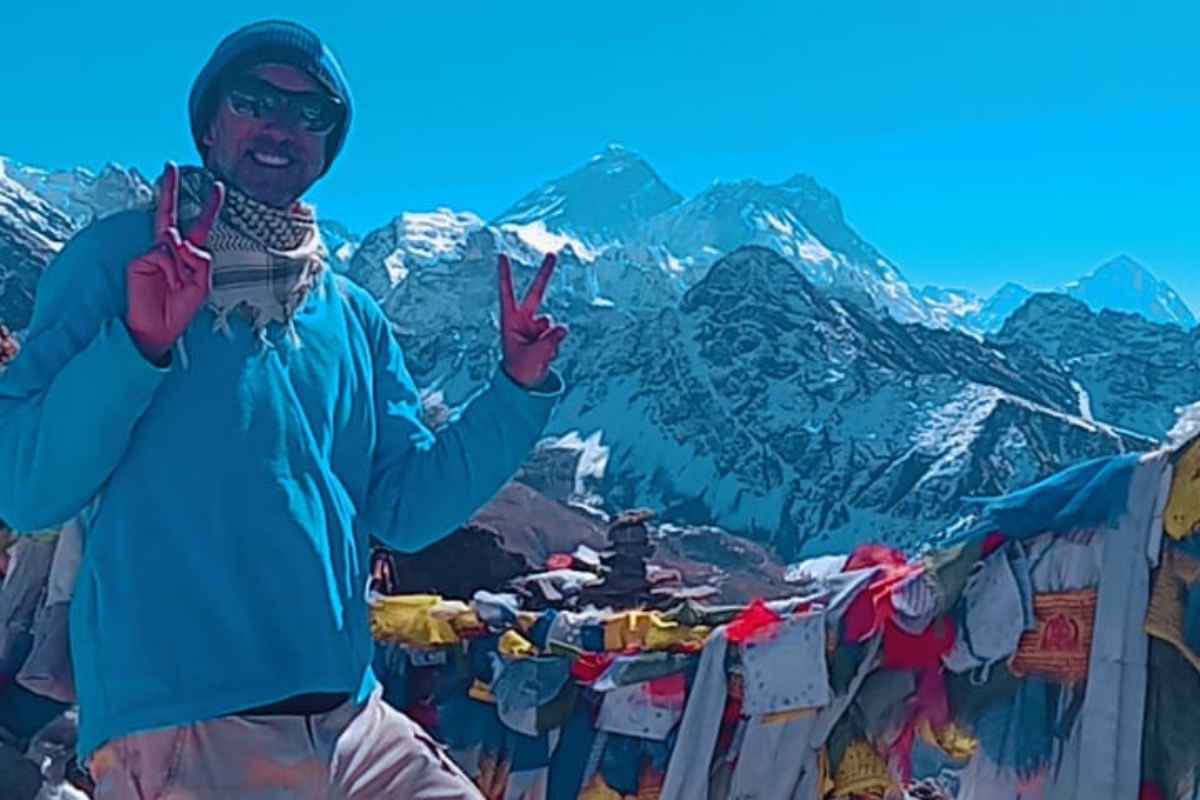
The first and highest pass of the circuit. Kongma La summits at 5,535m with Makalu, Lhotse, and Nuptse on the full horizon, then a steep, rocky descent to Lobuche. This is the hardest single day on the trek — a conservative pace matters more here than anywhere else on the route.
Altitude: 5,164m overnight / 5,364m at Base Camp | Total: 6–7 hrs | Meals: Breakfast, Lunch, Dinner | Stay: Teahouse, Gorakshep
The glacier moraine trail reaches Gorakshep. Daypacks stay behind for the walk to Everest Base Camp itself — a working expedition base at the foot of the Khumbu Icefall, not a viewpoint. We return to Gorakshep for the night.
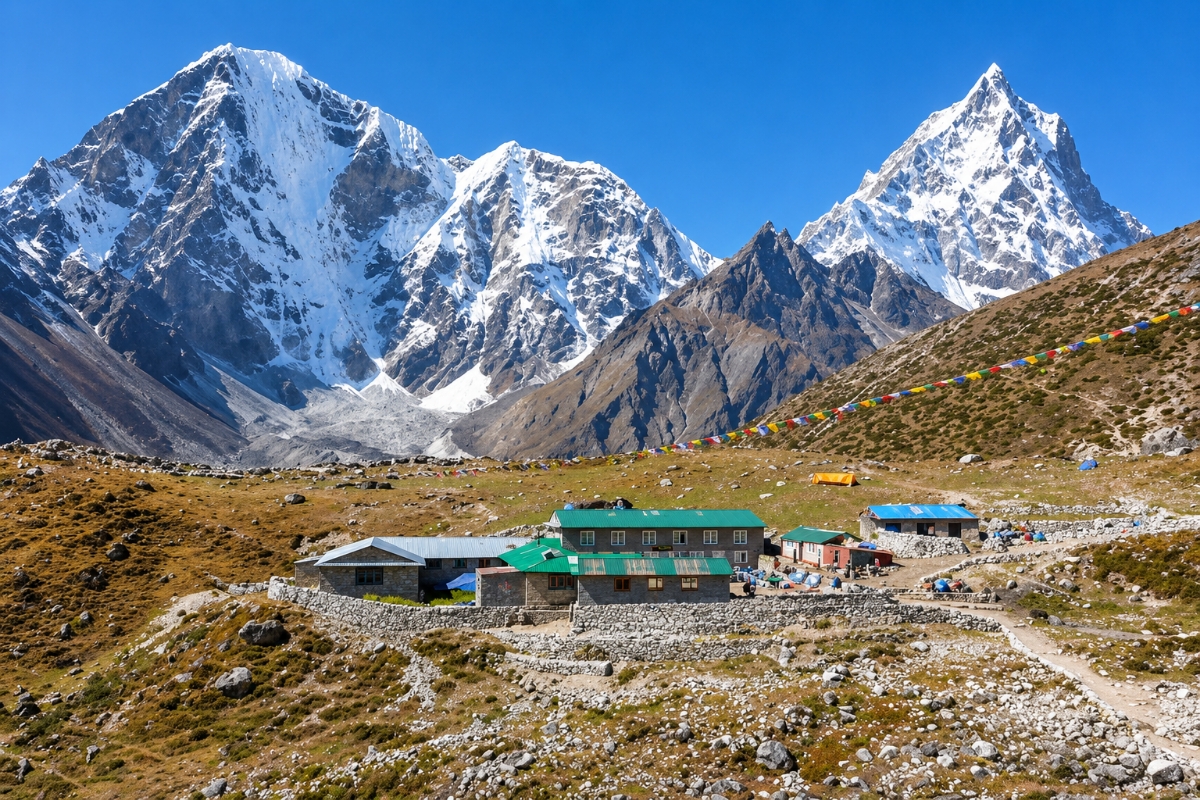
High point: 5,644m | Overnight: 4,830m | Total: 7–8 hrs | Meals: Breakfast, Lunch, Dinner | Stay: Teahouse, Dzongla
A 4:30am start for Kala Patthar — the highest point of the entire circuit, and the finest Everest sunrise view on the route. From there the team descends and continues west to Dzongla, the staging point for tomorrow’s second pass.
High point: 5,420m | Overnight: 4,750m | Trek: 7–8 hrs | Meals: Breakfast, Lunch, Dinner | Stay: Teahouse, Gokyo
The second and most technical pass. Cho La involves a boulder ascent and a glacier crossing near the top, where microspikes are often needed. From the pass, the trail drops into the Gokyo Valley — a landscape that looks nothing like the EBC side of the Khumbu, with six turquoise lakes and Cho Oyu rising above the village.
Altitude: 5,357m high point / 4,750m overnight | Hike: 3–4 hrs | Meals: Breakfast, Lunch, Dinner | Stay: Teahouse, Gokyo
A climb up Gokyo Ri delivers four 8,000m peaks at once — Everest, Lhotse, Makalu and Cho Oyu — plus a view down the full length of the Ngozumpa Glacier, Nepal’s longest.
Altitude: 4,380m | Trek: 4–5 hrs | Meals: Breakfast, Lunch, Dinner | Stay: Teahouse, Lungden
The trail moves north through the upper Gokyo Valley, past the least-visited of the six lakes, to Lungden — the staging point for the circuit’s third and final pass.
High point: 5,360m | Overnight: 3,820m | Trek: 7–8 hrs | Meals: Breakfast, Lunch, Dinner | Stay: Teahouse, Thame
The third and final pass. Renjo La gives one of the finest westward panoramas of the entire circuit — Everest, Lhotse and Makalu behind you, the Nangpa La trade route to Tibet ahead. The descent to Thame drops over 1,500m in a single day. Three passes crossed — the circuit is complete.
Altitude: 3,440m | Trek: 3–4 hrs | Meals: Breakfast, Lunch, Dinner | Stay: Teahouse, Namche Bazaar
A shorter day following the Bhote Koshi valley back to Namche — a different approach than the standard EBC route, and one of the more pleasant valley walks in the Khumbu.
Altitude: 2,860m | Trek: 5–6 hrs | Meals: Breakfast, Lunch, Dinner | Stay: Teahouse, Lukla
The final trekking day crosses the Hillary Suspension Bridge and the lower Dudh Koshi valley back to Lukla — three passes, two valleys, and fourteen days of altitude behind you.
Flight: 35 min | Meals: Breakfast
The morning flight returns to Kathmandu. Three passes, two valleys, Everest Base Camp, Gokyo Lakes, Kala Patthar at dawn — sixteen days, done.
Important: Always build 2–3 buffer days in Kathmandu after this flight. Lukla departures are weather-dependent, and delays are common enough to plan around.
The Three Passes Trek is rated challenging, significantly more demanding than the standard EBC route. The three pass crossings above 5,300m require sustained uphill endurance, sure footing on rocky and occasionally snowy terrain, and tolerance for early pre-dawn starts on pass days. Prior experience on at least one high-altitude trek above 4,500m is strongly recommended before attempting this circuit. For the full difficulty breakdown read: Everest Three Passes Trek difficulty guide →
Yes — round-trip domestic flights Kathmandu to Lukla and return are included in Mountain Hike Nepal’s package price. The round-trip sharing transfer from your Kathmandu hotel to Ramechhap Airport is also included — midnight departure, arriving 5:00–5:30am for the first morning flight window. Mountain Hike Nepal coordinates all flight logistics, so you don’t organise the Ramechhap transfer independently. Always build 2–3 buffer days in Kathmandu after the trek return.
Two permits cover the full circuit — the Sagarmatha National Park entry permit and the Khumbu Pasang Lhamu Rural Municipality permit. Both are included in Mountain Hike Nepal’s package price, with no independent purchase needed. Your guide handles all documentation at every checkpoint from Jorsale onward.
The Mountain Hike Nepal package starts from USD 1,499 for groups of 8–12 and USD 1,899 for solo trekkers — covering round-trip Lukla flights, Ramechhap transfer, all permits, all accommodation, all meals, and a licensed guide. For the complete cost breakdown read: Everest Three Passes Trek cost guide →
October is the finest month — post-monsoon clarity and the most reliable conditions on all three passes. April is the best spring month — strong conditions before the pre-monsoon haze, with rhododendron forests in bloom on the lower approach. Avoid June, July, and August — the Cho La glacier and Kongma La can be dangerous in monsoon conditions. For the full season guide read: Best time for Everest Three Passes Trek →
Microspikes or light crampons are strongly recommended for the Cho La glacier section, and occasionally for Kongma La in early spring or late autumn. Conditions vary by season, so always confirm current pass conditions with Mountain Hike Nepal at the time of booking, and rent microspikes in Kathmandu if advised. Trekking poles are non-negotiable for all three pass crossings regardless of season.
The EBC Trek is 12 days and reaches 5,644m at Kala Patthar, a linear out-and-back on the main Khumbu trail. The Three Passes Trek crosses three passes above 5,300m while visiting EBC, Gokyo Lakes, and Gokyo Ri in a full circuit that never repeats a major trail section. The Three Passes circuit is significantly more demanding but delivers a complete Khumbu experience the standard EBC route cannot provide. For the full comparison read: Everest Three Passes vs EBC Trek →
The highest pass is Kongma La at 5,535m, crossed on Day 7. The highest overall point of the circuit is Kala Patthar at 5,644m, reached before dawn for the Everest sunrise. Three of the circuit’s nights are spent above 4,700m — Gorakshep (5,164m), Dzongla (4,830m), and Gokyo (4,750m) — making this one of the most sustained high-altitude overnight schedules of any standard Nepal trekking circuit.
Not recommended for complete beginners. The three pass crossings and the technical Cho La glacier section demand a level of preparation and prior altitude experience that first-time Himalayan trekkers usually don’t have yet. The standard Everest Base Camp Trek is the recommended first Khumbu experience before attempting the Three Passes circuit.
Yes — travel insurance is required before Mountain Hike Nepal confirms any booking. The policy must explicitly cover trekking at this circuit’s highest point, Kala Patthar (5,644m), and helicopter evacuation from the Khumbu region. A policy capped at 5,000m or 5,500m will not cover you at Kala Patthar — most trekkers buy the next round band up, typically 6,000m, to clear it with margin. Confirm the altitude limit in writing with your insurer before departure.
Yes. We provide a complimentary roundtrip transfer to and from Tribhuvan International Airport for every Everest Three Passes Trek booking — pickup from the airport straight to your hotel in Thamel on arrival, and drop-off back to the airport on your departure day. This applies regardless of when you book relative to your arrival in Nepal.
Helicopter. A shared seat currently runs roughly $650–700 per person one way — heli pricing moves with fuel costs and passenger numbers, so treat this as a current rate, not a locked-in figure. For the return leg, we can arrange a pickup from Gorakshep, Dingboche, or Namche depending on how much of the circuit’s final descent you want to walk. Talk to us before you book and we’ll build the right option into your itinerary.
By road, on the B.P. Highway — the route runs east through Bhaktapur and Dhulikhel before reaching Manthali in Ramechhap district. Expect sharp bends and winding stretches for parts of the drive, which is why we use experienced drivers for this specific route, especially on the overnight run.
They still can, off-season — but during peak trekking months, Nepal’s Civil Aviation Authority reroutes scheduled Lukla flights through Manthali Airport in Ramechhap instead of Tribhuvan International Airport. It’s a congestion-management decision on CAAN’s part, not a change specific to any one airline or agency.
Yes — you can head to Manthali the day before your flight and stay there overnight rather than making the drive at midnight. It’s a valid option, though most of our clients still prefer the overnight transfer since it means one extra night in Kathmandu instead of a Ramechhap guesthouse.
Weather and airline scheduling decide this, not us — Lukla flights are affected by both. If it happens, we work with the airline to get you on the next available seat, and we’ll talk through a helicopter option with you if the delay runs long enough to threaten your itinerary.
Plan every aspect of this circuit with our detailed supporting guides: