Login

Sign Up

After creating an account, you'll be able to track your payment status, track the confirmation and you can also rate the tour after you finished the tour.
Username*
Password*
Confirm Password*
First Name*
Last Name*
Birth Date*
Email*
Phone*
Country*
* Creating an account means you're okay with our Terms of Service and Privacy Statement.
Please agree to all the terms and conditions before proceeding to the next step

Already a member?

Login
+977 985-1081173 / +977 980-1054414 [email protected] Govt.Regd.No 189775/74/075

 Manaslu Circuit Trek

0
Price
From$1,899$1,699
Price
From$1,899$1,699
Booking Form
Enquiry Form
Full Name*
Email Address*
Your Enquiry*
* I agree with Terms of Service and Privacy Statement.
Please agree to all the terms and conditions before proceeding to the next step
* Please select all required fields to proceed to the next step.

Proceed Booking

Save To Wish List

Adding item to wishlist requires an account

2970

Trip Overview

The Manaslu Circuit Trek is one of Nepal’s most rewarding and least crowded long-distance treks — a complete circuit around Mount Manaslu (8,163m), the eighth-highest peak on earth. Unlike the Annapurna Circuit or Everest Base Camp, the Manaslu region sits inside a restricted area. That status means fewer trekkers, more intact villages, and a trail that still feels like the Nepal of 25 years ago.

The route begins with a drive from Kathmandu to Machha Khola along the Budhi Gandaki river corridor. From there, the trail climbs through deep gorges, subtropical forest, and terraced hillside villages before entering the Tibetan-influenced landscape of the upper circuit. Samagaon and Samdo — the villages closest to the Tibet border — carry centuries of Buddhist culture in their monasteries, mani walls, and prayer flags.

The defining moment is crossing Larkya La Pass at 5,106m — demanding, beautiful, and unforgettable. After the pass, the trail descends through Bimthang into the Annapurna Conservation Area, completing the circuit.

Three permits are required — RAP, MCAP, and ACAP. Solo trekking without a licensed guide is not permitted. Mountain Hike Nepal handles all permits and logistics as part of the package.

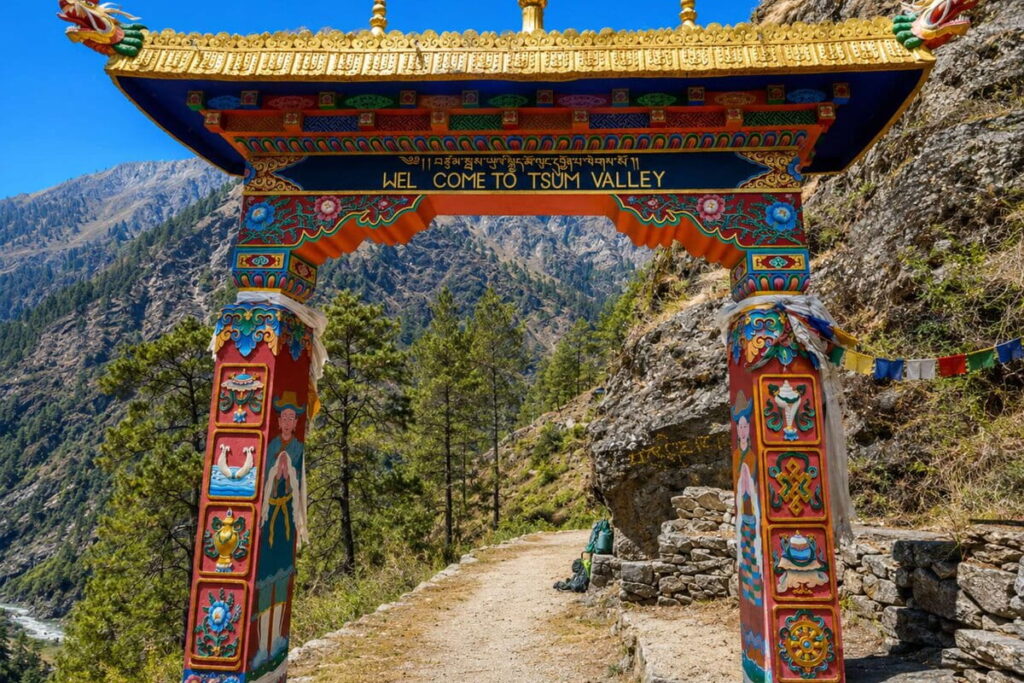
The itinerary can be customized to add Tsum Valley or connect to the Annapurna Circuit.

Item Information
Trip Name Manaslu Circuit Trek
Duration 13 Nights / 14 Days
Maximum Altitude 5,106m — Larkya La Pass
Major Highlights Larkya La Pass, Samagaon, Samdo, Budhi Gandaki Gorge, Bimthang
Trek Difficulty Challenging (Restricted Area, High-Altitude Pass)
Trek Start Point Machha Khola (from Kathmandu)
Trek End Point Dharapani (Besisahar road)
Best Season Spring (March–May) & Autumn (September–November)
Low Season Winter — cold, quieter trails, pass possible with preparation
Not Recommended Monsoon (July–August)
Accommodation Teahouse Lodges throughout
Meals Included Breakfast, Lunch & Dinner (during trek)
Trek Style Guided Restricted Area Circuit Trek
Region Manaslu Conservation Area + Annapurna Conservation Area
 

Route for the Manaslu Circuit Trek

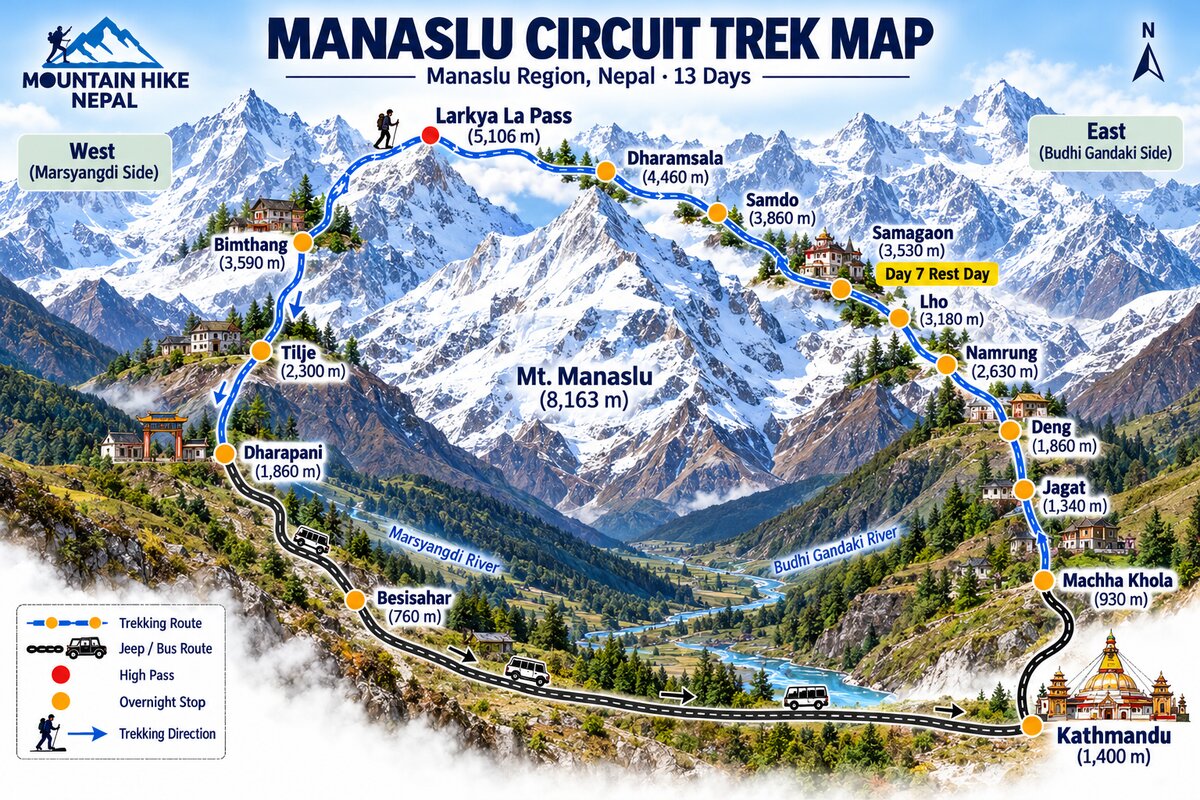
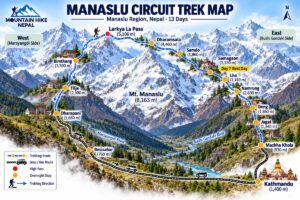
Kathmandu → Machha Khola → Jagat → Deng → Namrung → Lho → Samagaon → Samdo → Dharamsala (Larkya La Base Camp) → Larkya La Pass → Bimthang → Dharapani → Besisahar → Kathmandu

Why Choose the Manaslu Circuit Trek?

The Manaslu Circuit Trek offers something the Annapurna Circuit and Everest Base Camp can no longer deliver — genuine remoteness on a classic Himalayan route.

The restricted permit system limits daily trekker numbers across the entire circuit. As a result, you walk through villages where tourism is still modest and teahouses are still family-run. Larkya La Pass on a clear October morning might have 10 trekkers. Thorong La on the same day has several hundred.

The Budhi Gandaki gorge — narrow, dramatic, and deeply carved — is one of the most visually striking valley walks in Nepal.

Manaslu Circuit Trek Highlights

  • Crossing Larkya La Pass at 5,106m — the finest single trekking day in the Manaslu region
  • Walking the full length of the Budhi Gandaki gorge — dramatic, narrow, and genuinely remote
  • Overnight at Samagaon (3,520m) — a Tibetan-influenced village with direct views of Manaslu’s south face
  • Trekking to the Tibet border ridge above Samdo on the acclimatisation day
  • Completing a genuine mountain circuit around the eighth-highest peak on earth

Who Is the Manaslu Circuit Trek For?

  • Trekkers who have completed the Annapurna Circuit or Everest Base Camp and want a more challenging, less crowded next step
  • Adventurers specifically seeking a restricted area experience with authentic Tibetan-influenced culture
  • Trekkers comfortable with 6–8 hours of walking per day across remote, high-altitude terrain
  • Those prepared for a genuine mountain pass crossing at 5,106m
  • Small groups, couples, and solo adventurers (minimum 2 trekkers required for the Restricted Area Permit)

This trek is not recommended for first-time Himalayan trekkers or those without prior high-altitude experience above 4,000m.

Why Trek With Mountain Hike Nepal?

  • Licensed local guides with specific Manaslu region experience — not generic Himalayan guides
  • Full permit handling — Restricted Area Permit (RAP), MCAP, and ACAP all arranged on your behalf
  • Strong focus on acclimatisation pacing — we never rush the approach to Larkya La
  • Small, well-managed groups — personal attention on a demanding route
  • Emergency contacts and evacuation coordination across the full circuit
  • Clear, honest pricing with no hidden costs

The Manaslu Circuit requires a higher level of logistical expertise than standard teahouse treks. Mountain Hike Nepal has guided this route extensively — we know where the weather turns, which acclimatisation stops matter, and how to read the Larkya La crossing conditions before committing the group.

Manaslu Circuit Trek Cost

Solo Trekker

$1,699

per person

  • Licensed expert trekking guide
  • Licensed expert guide with Manaslu experience
  • All 3 permits included (RAP + MCAP + ACAP)
  • Flexible departure date
  • Full logistical support throughout
  • Best for independent travellers

Chat Now

5–7 Trekkers

$1,299

per person

  • Experienced guide and support team
  • All permits included
  • Smooth group coordination
  • Best for small groups and families

Chat Now

8–12 Trekkers

$1099

per person

  • Dedicated trekking crew
  • All permits included
  • Full logistical support
  • Best for teams and large groups

Chat Now

Price Includes

✅ All ground transportation — Kathmandu to Machha Khola & Dharapani to Kathmandu (local jeep/bus)
✅ All trekking accommodation in local teahouse lodges (twin-sharing basis)
✅ All meals during the trek — Breakfast, Lunch & Dinner, including morning tea or coffee
✅ Licensed, experienced English-speaking trekking guide
✅ One strong local porter (1 porter per 2 trekkers, maximum load 18 kg)
✅ All required permits — Restricted Area Permit (RAP), Manaslu Conservation Area Permit (MCAP), and Annapurna Conservation Area Permit (ACAP)
✅ Chumnubri Rural Municipality local fee
✅ Guide and porter wages, meals, accommodation, insurance, and local transport
✅ Necessary staff equipment and full logistical support
✅ All applicable government taxes and service charges

Price Excludes

❌ International airfare to and from Nepal
❌ Nepal entry visa fee (available on arrival — USD 50 for 30 days)
❌ Travel and medical insurance (must cover high-altitude trekking above 5,000m and emergency helicopter evacuation)
❌ Personal trekking gear, equipment, and medications
❌ Hotel and meals in Kathmandu before and after the trek
❌ Hot showers, Wi-Fi, and device charging on the trail (available for a small fee at most teahouses)
❌ Alcoholic beverages, bottled drinks, snacks, and personal expenses
❌ Tips for guide and porter (customary and appreciated)
❌ Additional accommodation or meals due to early arrival, late departure, or itinerary changes
❌ Any costs arising from natural events, weather delays, road conditions, or circumstances beyond our control

Manaslu Circuit Trek Itinerary

Day 01 — Drive from Kathmandu to Machha Khola

Altitude: 930m | Drive: 8–9 hours | Meals: Breakfast, Lunch, Dinner | Stay: Teahouse, Machha Khola

The Manaslu Circuit Trek begins with a long drive west from Kathmandu — and it sets the tone immediately. You follow the Prithvi Highway out of the valley before turning north into the Budhi Gandaki river corridor, pushing steadily deeper into the Gorkha district through market towns, terraced farming villages, and increasingly remote hillside communities.

The road beyond Arughat becomes rougher and slower — this is not a polished highway but a mountain road that earns its scenery. By the time Machha Khola appears, the city feels very far away. That distance is the point.

Machha Khola sits at 930m beside the river — a quiet cluster of teahouses that marks the operational start of the circuit. Use the evening to check gear, confirm permits with your guide, and rest properly. The first walking day starts early tomorrow.


Day 02 — Trek from Machha Khola to Jagat

Altitude: 1,340m | Trek: 22 km | Walking Time: 6–7 hours | Meals: Breakfast, Lunch, Dinner | Stay: Teahouse, Jagat

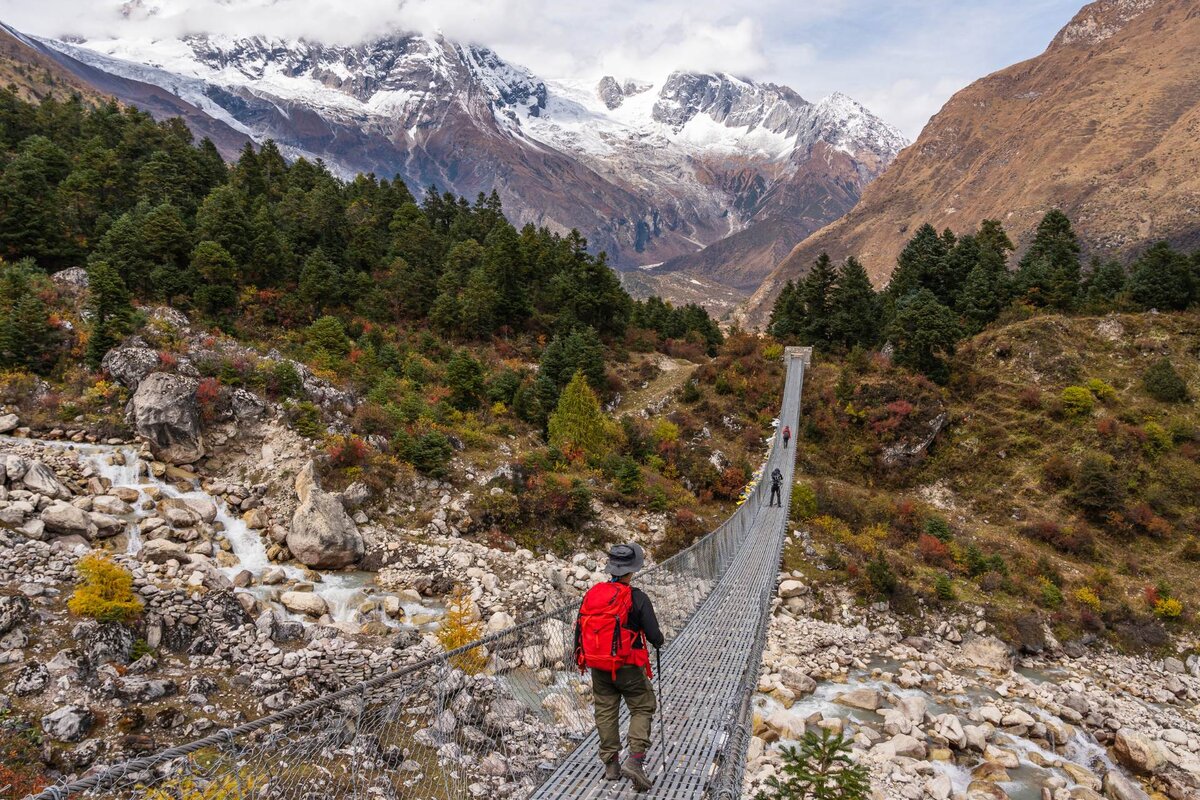
This is your first full day on the Manaslu Circuit Trek trail — and it delivers immediately. The route follows the Budhi Gandaki river upstream through a series of riverside villages, suspension bridges, sal forests, and rocky cliff sections where the gorge begins to narrow for the first time.

The trail passes through Kholabesi, Tatopani, and Dobhan before climbing through forested hillside to Jagat. Along the way, waterfalls drop from the cliffs above, mule trains share the path, and the first Himalayan foothills rise on either side of the valley.

Jagat is the first official checkpoint on the Manaslu restricted area circuit. Your guide handles the permit check — have your documents accessible. From this point forward, the trail leaves road access behind entirely and the real trek begins.


Day 03 — Trek from Jagat to Deng

Altitude: 1,860m | Trek: 20 km | Walking Time: 6–7 hours | Ascent: +520m | Meals: Breakfast, Lunch, Dinner | Stay: Teahouse, Deng

The Budhi Gandaki gorge tightens dramatically today. The trail pushes north through Salleri, Sirdibas, and Ghap — narrow sections where the river is a constant presence, the valley walls rise sharply on both sides, and the outside world feels genuinely far away.

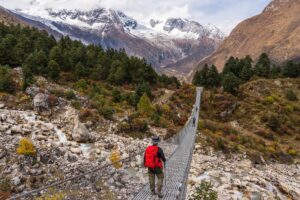
This section of the Manaslu Circuit route features some of the most dramatic gorge walking in all of Nepal. Waterfalls emerge from nowhere on both walls. The trail crosses and recrosses the river on suspension bridges. Dense forest alternates with open rock face sections that demand full attention underfoot.

Deng sits at a forested bend in the valley — quiet, simple, and well-positioned for the altitude gain ahead. Newly built stone steps between Jagat and Deng have improved the trail significantly compared to previous years. Nevertheless, the distance and vertical effort make this one of the longer days on the lower circuit.


Day 04 — Trek from Deng to Namrung

Altitude: 2,630m | Trek: 18 km | Walking Time: 6–7 hours | Ascent: +770m | Meals: Breakfast, Lunch, Dinner | Stay: Teahouse, Namrung

Today the valley begins to open and the first serious altitude gain of the Manaslu Circuit Trek arrives. The trail climbs steadily north through Rana and Bihi — small, traditional communities where Gurung and Tibetan-speaking families have farmed this valley for generations.

Above Bihi, the subtropical forest begins to give way to pine and the air noticeably cools. The first clear views of the surrounding Himalayan ridgelines appear as the gorge opens into a wider valley section. Siringi Himal and the flanks of the Ganesh Himal range become visible for the first time.

Namrung at 2,630m marks the transition point between the lower and mid sections of the circuit. The teahouses here are well-equipped and the village is a good place for a longer rest stop. From Namrung northward, the Manaslu trekking region takes on a distinctly more alpine and Tibetan character with every day.


Day 05 — Trek from Namrung to Lho

Altitude: 3,180m | Trek: 10 km | Walking Time: 5–6 hours | Ascent: +550m | Meals: Breakfast, Lunch, Dinner | Stay: Teahouse, Lho

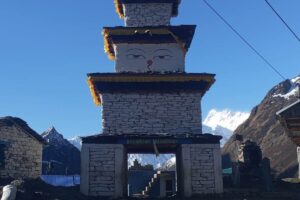
This is one of the most visually rewarding days on the entire Manaslu Circuit Trek. The trail passes through the ancient villages of Lihi and Sho — Tibetan-influenced settlements where prayer flags, mani walls, and stone chortens line the path — before reaching Lho with its extraordinary mountain backdrop.

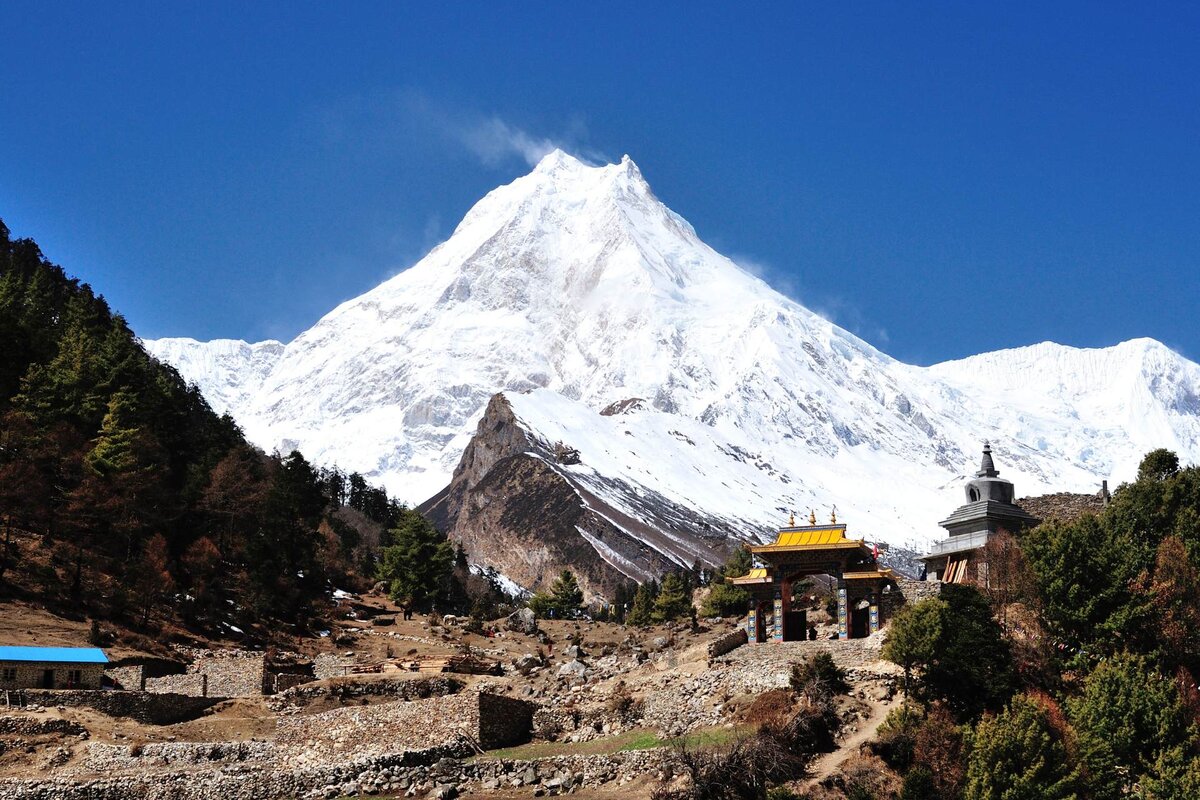
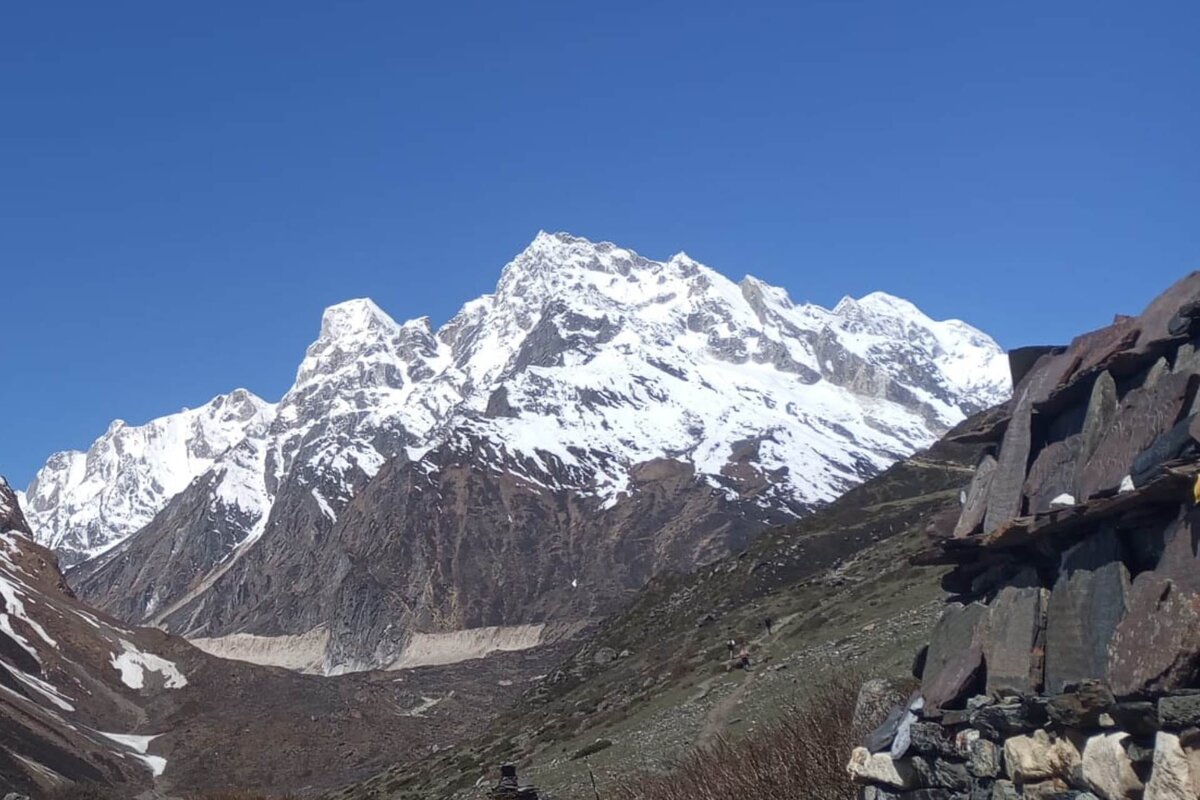
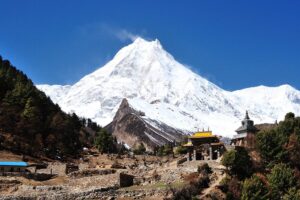
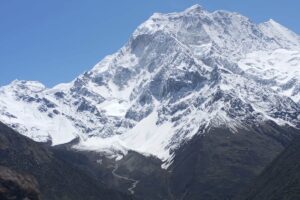
From Lho, the full south face of Mount Manaslu (8,163m) fills the horizon directly ahead. This is the first truly close-range view of the eighth-highest peak on earth, and most trekkers stop walking and simply stare for several minutes when it first appears.

Above Lho sits Pungyen Monastery — one of the most atmospheric and ancient gompas in the entire region. The afternoon hike up to the monastery is strongly recommended. The views of Manaslu from the monastery terrace are unlike anything available from the trail below, and the monastery itself is still actively used by local monks. Do not skip this visit.


Day 06 — Trek from Lho to Samagaon

Altitude: 3,520m | Trek: 9 km | Walking Time: 4–5 hours | Ascent: +340m | Meals: Breakfast, Lunch, Dinner | Stay: Teahouse, Samagaon

A shorter but significant walking day. The trail climbs gradually through yak pastures and open alpine meadow, passing through Shyala before the path opens into the wide upper valley that holds Samagaon — the cultural heart of the upper Manaslu Circuit.

Samagaon is the largest and most culturally significant village on the high circuit. It is a deeply Tibetan community — prayer flags stretch between rooftops, the local monastery echoes with chanting in the early morning, and the residents speak a dialect closer to Tibetan than Nepali. The entire south face of Manaslu rises directly above the village, creating one of the most dramatic mountain backdrops in all of Nepal trekking.

Arrive early, rest completely, and drink at least 3 litres of water. Tomorrow is the acclimatisation day — the most important rest day on the entire Manaslu trekking itinerary.


Day 07 — Acclimatisation Day in Samagaon

Altitude: 3,520m | Rest Day | Side Hike: Up to 4,800m (optional) | Meals: Breakfast, Lunch, Dinner | Stay: Teahouse, Samagaon

This rest day in Samagaon is non-negotiable. The body needs time at 3,520m before the circuit pushes higher toward Larkya La Pass — and Samagaon gives you two outstanding options for the acclimatisation hike.

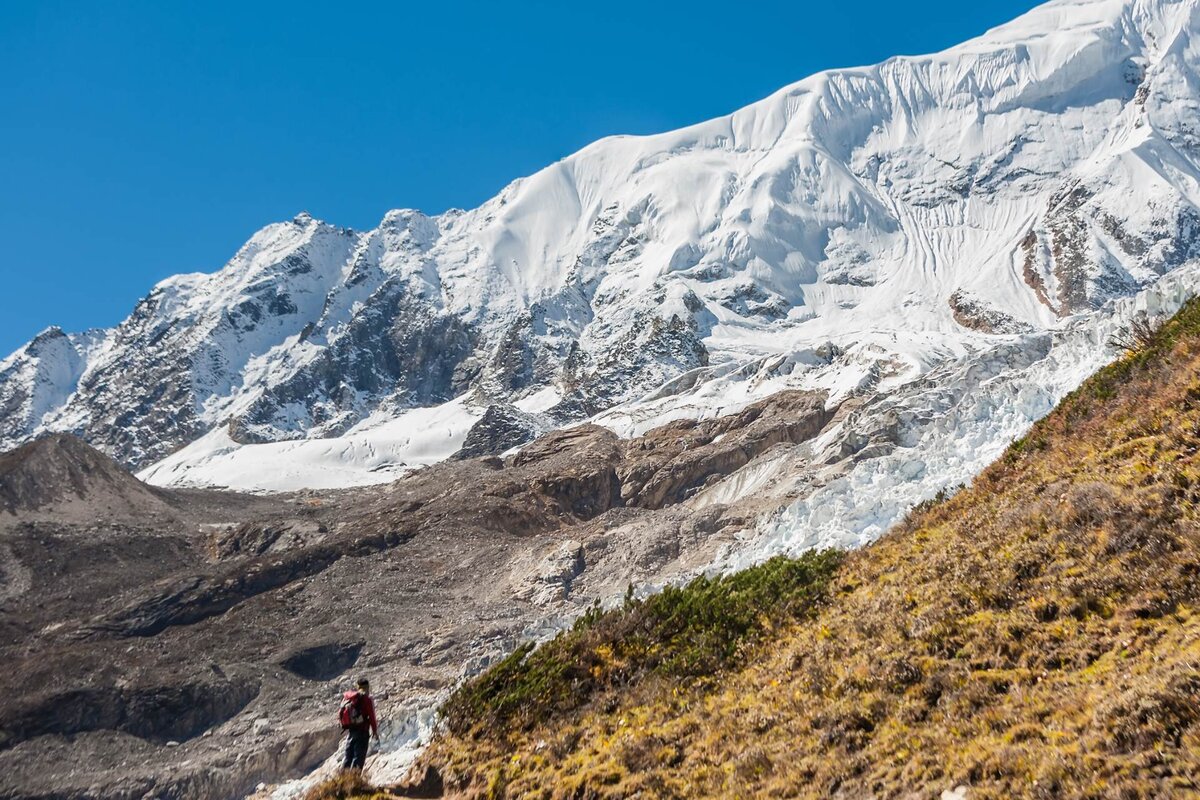
Option 1 — Manaslu Base Camp (4,800m): A demanding 5–6 hour return hike through glacial moraine to close-range views of Manaslu’s icefalls and the surrounding Himalayan walls. This is the best altitude preparation for Larkya La and gives experienced trekkers a genuine sense of the mountain’s scale. The Manaslu Base Camp hike is one of the finest side trips on any Nepal trekking circuit.

Option 2 — Birendra Lake (3,750m): A shorter, more relaxed hike to a sacred glacial lake sitting above the village in a wide moraine bowl. The turquoise water, strong mountain views, and cultural significance of the lake make this the right choice for trekkers who want acclimatisation without the full base camp effort.

Whichever option you choose, return to Samagaon by early afternoon, eat a full dinner, and sleep as much as possible. The circuit’s hardest days lie immediately ahead.


Day 08 — Trek from Samagaon to Samdo

Altitude: 3,860m | Trek: 8 km | Walking Time: 3–4 hours | Ascent: +340m | Meals: Breakfast, Lunch, Dinner | Stay: Teahouse, Samdo

A deliberately short walking day — today is about altitude, not distance. The trail follows yak paths across open high-altitude terrain, crossing a series of ridgelines as the valley narrows and the peaks on either side grow closer and more imposing.

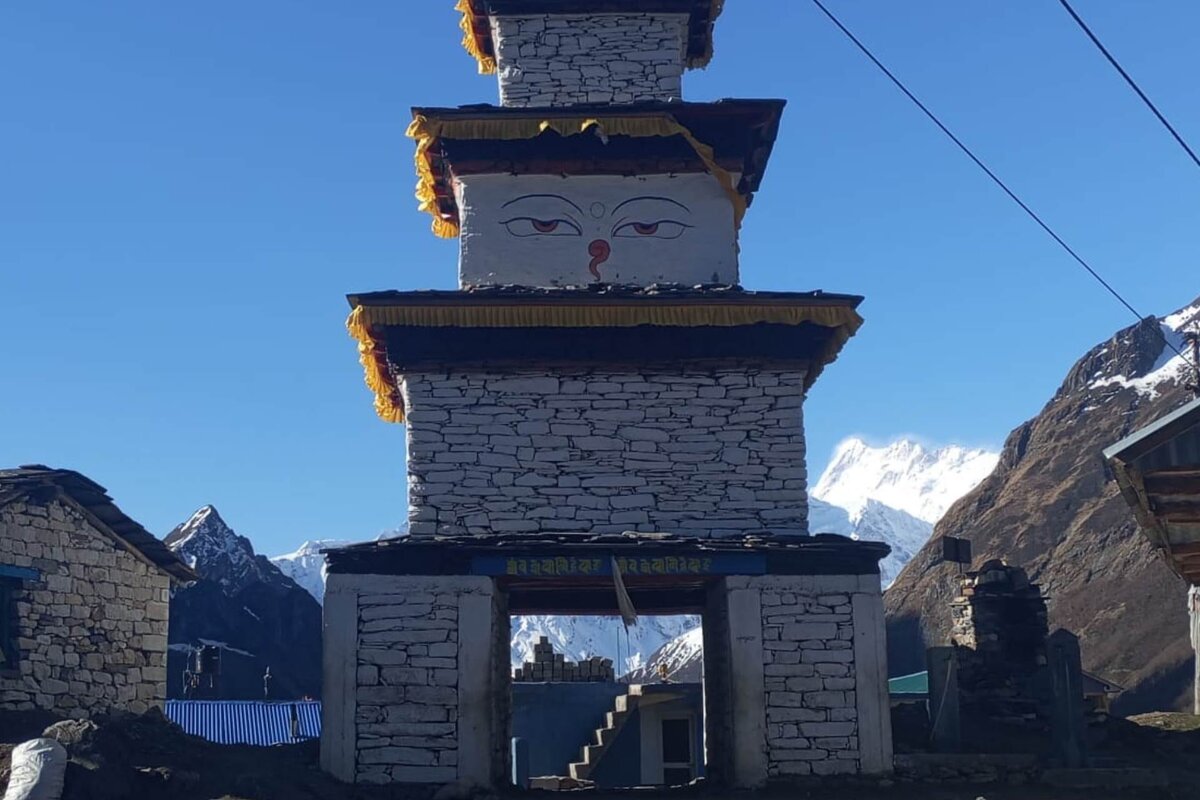
Samdo sits at 3,860m — the highest permanently inhabited village on the Manaslu Circuit and one of the most remote communities in Nepal. Only a few kilometres separate Samdo from the Tibet border, and the Tibetan cultural influence is more pronounced here than anywhere else on the circuit. The stone houses, the yak herds, and the older residents’ dress all reflect a way of life largely unchanged for centuries.

In the afternoon, your guide leads a short acclimatisation walk toward the Nepal-Tibet border ridge above the village. The views across the Tibetan plateau from this ridge are extraordinary — dry, vast, and completely unlike the lush valley below. This is one of the most unusual and memorable short hikes on the entire Manaslu Circuit Trek.


Day 09 — Trek from Samdo to Dharamsala (Larkya La Base Camp)

Altitude: 4,460m | Trek: 9 km | Walking Time: 4–5 hours | Ascent: +600m | Meals: Breakfast, Lunch, Dinner | Stay: Teahouse, Dharamsala

Today the circuit enters its most committed section. The trail climbs through sparse high-alpine terrain — fewer plants, more exposed rock, visibly thinner air — to Dharamsala, also known as Larkya La Base Camp. This is where the pass crossing begins in earnest tomorrow.

Dharamsala at 4,460m is basic. A small cluster of teahouses offers cold rooms, limited menus, and unreliable electricity. Nevertheless, arriving in the mid-afternoon gives the body several hours to adjust to the altitude before the early morning start. The effort tomorrow demands everything — so the preparation tonight matters.

Drink at least 4 litres of water throughout the day and evening. Eat a full dinner even if appetite is reduced. Lay out your warmest gear and headlamp before sleeping. Most groups depart Dharamsala between 3am and 4am — your guide confirms the exact time based on conditions and group pace.


Day 10 — Cross Larkya La Pass (5,106m) — Descend to Bimthang

Altitude: 5,106m → 3,590m | Trek: 14 km | Walking Time: 8–10 hours | Ascent: +646m | Descent: -870m | Meals: Breakfast, Lunch, Dinner | Stay: Teahouse, Bimthang

This is the day the entire Manaslu Circuit Trek builds toward.

Departure by headlamp in the pre-dawn cold. The trail climbs through glacial moraine and across open snowfield in near-darkness, the beam of your headlamp picking out cairns and footprints in the snow ahead. By the time the sky begins to lighten, the pass is within reach.

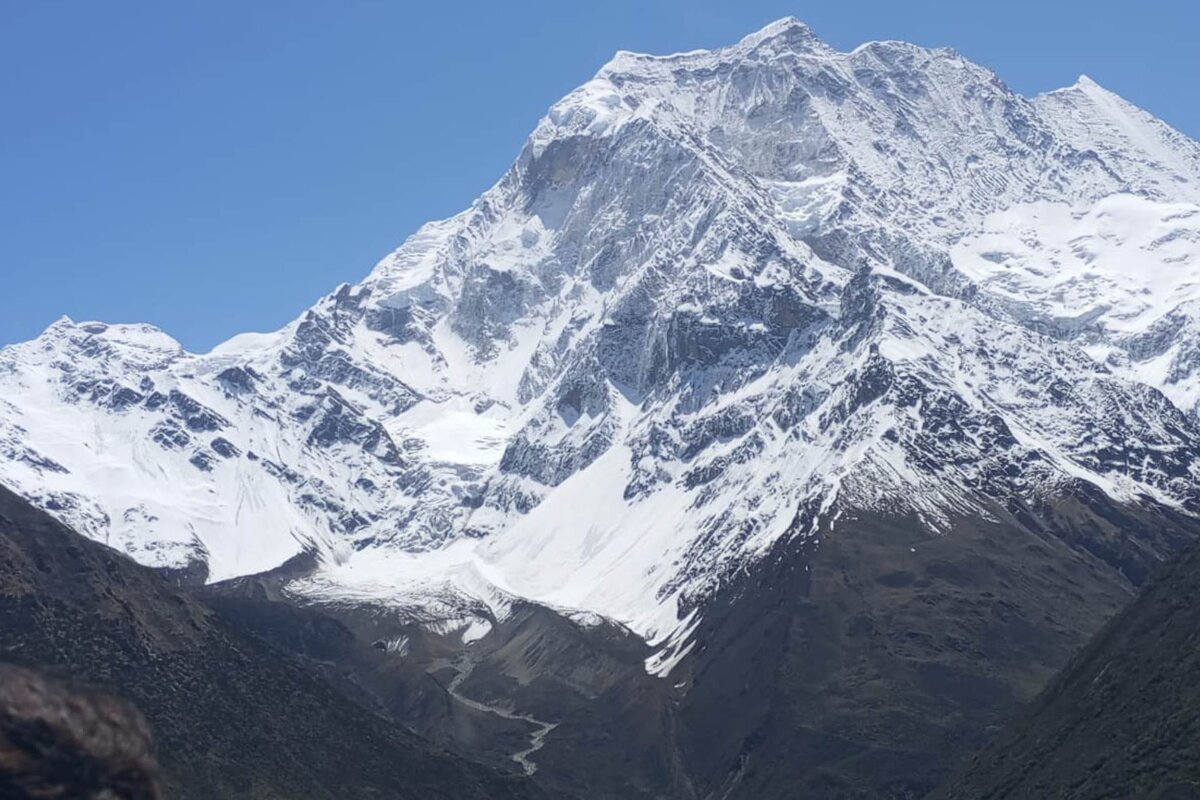
Larkya La at 5,106m is a wide, high-altitude col — exposed, wind-scoured, and surrounded on all sides by some of the finest peaks in western Nepal. Himlung Himal, Cheo Himal, Kang Guru, and Annapurna II line the horizon. The views on a clear October or April morning are genuinely extraordinary — and the sense of achievement at the top of this pass is unlike anything available on a standard Nepal trek.

The descent drops steeply through loose scree and open glacial valley into Bimthang — a wide, beautiful glacial meadow at 3,590m with mountain views stretching in every direction. Most trekkers arrive in Bimthang tired to the bone but deeply satisfied. The hardest section of the Manaslu Circuit is behind you. The rest is descent.


Day 11 — Trek from Bimthang to Tilje

Altitude: 2,300m | Trek: 16 km | Walking Time: 6–7 hours | Descent: -1,290m | Meals: Breakfast, Lunch, Dinner | Stay: Teahouse, Tilje

A long descent day through one of the most dramatic ecological transitions on the entire route. The trail drops from open glacial terrain at Bimthang through dense rhododendron and pine forest before reaching the warmer, greener Marsyangdi valley near Tilje — a descent of nearly 1,300 vertical metres in a single day.

The transition from high-altitude alpine to lush temperate forest is one of the most striking experiences on the Manaslu Circuit Trek. With each hundred metres of descent, trees reappear, birdlife returns, and the air grows noticeably richer. Breathing becomes easier with every kilometre.

Trekking poles are strongly recommended for this section — the sustained downhill places real impact on the knees over 16 km. Nevertheless, the valley scenery, the improving oxygen levels, and the knowledge that the pass is behind you make this one of the most enjoyable walking days of the circuit.


Day 12 — Trek from Tilje to Dharapani

Altitude: 1,860m | Trek: 8 km | Walking Time: 4–5 hours | Descent: -440m | Meals: Breakfast, Lunch, Dinner | Stay: Teahouse, Dharapani

The final trekking day of the Manaslu Circuit Trek. The trail follows the Marsyangdi river downstream through the villages of Thonje and Kobang before reaching Dharapani — the point where the Manaslu circuit trail formally meets the Annapurna Circuit route.

It is a short, pleasant walking day — the path is clear, the valley is wide and green, and the legs carry less weight than they have at any point since Machha Khola. Reaching Dharapani marks the official end of the restricted area and the completion of the circuit around Mount Manaslu.

Your guide arranges the return jeep from Dharapani or nearby Besisahar for the drive back to Kathmandu. Use the evening to reflect on what the circuit has covered — deep gorges, Tibetan villages, glacial lakes, the highest pass, the descent through forest. It was all of it.


Day 13 — Drive from Dharapani to Kathmandu

Altitude: 1,400m | Drive: 7–8 hours | Meals: Breakfast, Lunch | Stay: Hotel, Kathmandu

The return drive follows the Marsyangdi river downstream to Besisahar before joining the Prithvi Highway back to Kathmandu. The road is considerably more comfortable than the Machha Khola route at the start — well-surfaced for most of the journey and markedly less bumpy than Day 01.

Use the drive to rest. The window scenery passes in reverse — from alpine to subtropical, from gorge to river plain, from mountain to city. By the time Kathmandu appears on the horizon, the circuit is complete.

Your guide accompanies the group to the hotel. The evening is free — dinner in Thamel, a final debrief with your guide, or simply the quiet satisfaction of a long sleep in a warm room at low altitude.


Day 14 — Final Day in Kathmandu / Departure

Altitude: 1,400m | Meals: Breakfast

The last day of the Manaslu Circuit Trek package. Use the morning for any remaining souvenir shopping, gear returns, or simply a quiet breakfast before your onward flight. Mountain Hike Nepal arranges airport transfer and assists with any final logistics.

The circuit took 14 days, covered 180 km, crossed one of Nepal’s great mountain passes, and circled the eighth-highest peak on earth. Most trekkers leave Nepal already thinking about coming back.

Manaslu Circuit Trek – Frequently Asked Questions

What permits do I need for the Manaslu Circuit Trek?

Three permits are required: the Restricted Area Permit (RAP), the Manaslu Conservation Area Permit (MCAP), and the Annapurna Conservation Area Permit (ACAP). Furthermore, a Chumnubri Rural Municipality local fee of NPR 1,000 per person is collected on the trail. Important update for 2026: TIMS cards are no longer required for the Manaslu Circuit — if any operator tells you otherwise, they are misinformed. Mountain Hike Nepal arranges all permits on your behalf as part of the package — you are not required to visit any government office personally.

How much do the Manaslu Circuit Trek permits cost in 2026?

Permit costs vary by season. The Restricted Area Permit (RAP) costs USD 100 for the first 7 days during peak season (September to November), with USD 15 per additional day. During off-peak months (December to August), the cost drops to USD 75 for the first 7 days, with USD 10 per additional day. Additionally, both the MCAP and ACAP cost approximately USD 30 each per person. Consequently, total permit costs for a 14-day trek in October run approximately USD 175–185 per person — all of which are included in Mountain Hike Nepal’s package price with no hidden fees.

Can I trek the Manaslu Circuit solo in 2026?

Yes and no — and this is important to understand clearly. As of March 22, 2026, Nepal’s Department of Immigration removed the two-person minimum for the Restricted Area Permit, so solo trekkers can now apply individually without needing a second foreign trekker. However, what did not change is the mandatory licensed guide requirement. A licensed guide is still legally required for every trekker on the Manaslu Circuit — solo or in a group — and this is enforced at all checkpoints. Consequently, the new rule simply means you can now book a private trek with just yourself and your guide, without needing to find a trekking partner first.

How difficult is the Manaslu Circuit Trek?

The Manaslu Circuit Trek is rated moderate to challenging — and that rating should be taken seriously. The difficulty comes from three factors working together: the remote and underdeveloped trail above Jagat, the sustained multi-day duration at high altitude, and the Larkya La Pass crossing at 5,106m. Furthermore, medical facilities above Jagat are extremely basic, with helicopter evacuation being the primary emergency option. Prior high-altitude trekking experience above 4,000m is strongly recommended — trekkers who have completed the Annapurna Base Camp or Everest Base Camp are well-placed to take on the Manaslu Circuit as a natural next step.

How does the Manaslu Circuit compare to Everest Base Camp and the Annapurna Circuit?

The Manaslu Circuit sits between EBC and the Annapurna Circuit in terms of overall challenge. EBC reaches a higher maximum altitude (5,364m vs 5,106m), but the Manaslu Circuit involves a genuine mountain pass crossing rather than a walk to a viewpoint — which many trekkers find more rewarding. Compared to the Annapurna Circuit, Manaslu is quieter, more remote, and culturally richer, but also more demanding logistically. Furthermore, crowd levels are dramatically lower — Larkya La on a peak-season day sees 10–20 trekkers, while Thorong La on the Annapurna Circuit sees several hundred. Most trekkers who have done all three rank the Manaslu Circuit as the finest overall experience.

What is the best time to trek the Manaslu Circuit?

Autumn (September to November) offers the most stable weather and the clearest conditions for crossing Larkya La Pass — October is the single best month on the entire circuit. Spring (March to May) is the second-best season, with rhododendrons in bloom on the lower trail, longer daylight hours, and generally good pass conditions through late April. Furthermore, early October and early April both offer the best balance of good weather and manageable crowds on the trail. The monsoon (July to August) is the one season to avoid — trail flooding, landslide risk, and poor visibility at the pass make it unsuitable for most trekkers.

Can I do the Manaslu Circuit Trek in winter?

Winter trekking on the Manaslu Circuit is possible for experienced, well-equipped trekkers — and it offers something genuinely rare: the trail almost entirely to yourself. Nevertheless, Larkya La Pass can be blocked by snow from December through February, and some teahouses in the upper sections reduce their services or close temporarily. Consequently, winter attempts require real-time condition checking with your guide, flexibility on dates, and proper cold-weather gear including a sleeping bag rated to at least -15°C. Contact us directly to discuss winter departure feasibility — our guides monitor trail conditions throughout the year and can advise on the best specific window.

Is altitude sickness a serious risk on the Manaslu Circuit?

Yes — altitude sickness is a real and significant risk on this trek, particularly on Days 6 through 10 as the route climbs from Samagaon (3,520m) to Larkya La Pass (5,106m). Mild symptoms — headache, reduced appetite, and disrupted sleep — are common above 3,500m and manageable with proper pacing and hydration. However, the remote location means medical facilities above Jagat are extremely basic, and helicopter evacuation is often the only realistic emergency option. As a result, your guide’s altitude assessment each morning before ascending is your most important safety tool — never ascend with worsening symptoms, and ensure your travel insurance covers helicopter evacuation above 5,000m before you book.

What time do trekkers start the Larkya La Pass crossing?

Most groups depart Dharamsala (Larkya La Base Camp) between 3am and 4am on the pass crossing day. The early start ensures full daylight for the long descent from the pass to Bimthang and reduces the risk of afternoon weather building on the exposed upper pass. Furthermore, crossing in the early morning hours means the snow surface is firmer and more stable than in the warmer afternoon hours. Your guide confirms the exact departure time the evening before, based on current trail conditions, group fitness, and weather. Consequently, laying out your warmest gear and headlamp before sleeping that night is important — a 3am departure in the dark requires everything to be within immediate reach.

What is the food like on the Manaslu Circuit Trek?

Teahouses throughout the Manaslu Circuit serve a standard trekking menu of dal bhat, noodle soup, pasta, fried rice, eggs, porridge, and a range of hot drinks. Dal bhat is by far the best value and most nutritionally complete meal on the trail — it comes with unlimited refills at a fixed price and is freshly cooked at every teahouse. Furthermore, menus become simpler above Samagaon and at Dharamsala, where supply logistics are most complex. Nevertheless, the cooking is good and the portions are generous throughout the circuit — your body gets exactly what it needs at altitude, even if the menu variety narrows in the upper sections.

Is travel insurance mandatory for the Manaslu Circuit Trek?

Yes — without exception. Your policy must specifically cover high-altitude trekking above 5,000m and emergency helicopter evacuation from a restricted area. Helicopter rescue from inside the Manaslu restricted area costs between USD 4,000 and USD 8,000 without coverage — a figure that has ended many post-trek financial plans. Furthermore, the remote location of the upper circuit means helicopter evacuation is often the only realistic emergency option above Jagat. Standard travel insurance covering only cancellations and baggage is not sufficient — confirm with your insurer that your policy explicitly covers trekking above 5,000m and helicopter evacuation in Nepal before you book.

How far in advance should I book the Manaslu Circuit Trek?

For autumn departures (September to November), book at least 3 months in advance — ideally by July for October dates. October is the most popular month on the circuit and experienced guides with specific Manaslu knowledge get fully booked well before the season opens. Furthermore, permit processing takes 1–2 business days under normal conditions but can take 3–4 days during peak October when government offices are overwhelmed with applications. Consequently, arriving in Kathmandu without sufficient lead time before your planned start date is a genuine risk if you book late. For spring departures, booking 6–8 weeks in advance is generally sufficient, though April dates fill faster than March or May.

Can I add the Tsum Valley to the Manaslu Circuit Trek?

Yes — the Tsum Valley is a popular and highly rewarding extension that adds 7–10 days to the standard Manaslu Circuit itinerary. The valley branches off the main circuit in the lower section and leads north into one of the most culturally preserved Tibetan Buddhist communities in Nepal. Furthermore, the Tsum Valley requires a separate restricted area permit costing approximately USD 40 for the first 7 days during peak season. Consequently, the combined Manaslu Circuit and Tsum Valley trek typically runs 20–24 days total. Contact us to discuss combined itinerary options and current permit costs — we have run both routes extensively and can tailor the right itinerary for your time and fitness level.

Are there permit checkpoints on the Manaslu Circuit route?

Yes — there are eight permit checkpoints along the Manaslu Circuit route, located at Arughat (entry), Jagat, Philim, Deng, Namrung, Samagaon, Samdo, and Bimthang. At each checkpoint, officials photograph your permit, record your details, and sign you through. The system is consistently enforced — any trekker attempting to pass a checkpoint without a valid RAP faces immediate return to Kathmandu. Furthermore, your guide carries the original permit documentation and handles all checkpoint interactions on your behalf. Consequently, your only responsibility is to keep your passport copy accessible in your daypack throughout the trek.

What should I do if I feel unwell on the Manaslu Circuit Trek?

Tell your guide immediately — do not try to manage symptoms alone or continue ascending without informing them first. Your guide is trained to assess altitude sickness symptoms and make descent decisions based on real trail experience. The golden rule on the Manaslu Circuit is straightforward: if symptoms are worsening at the same altitude after 12 hours of rest, you descend. Furthermore, above Jagat the nearest facility capable of treating serious altitude illness is far away — which is why early reporting and your guide’s judgment are your most important safety tools. That said, the vast majority of trekkers who follow the 14-day itinerary at a sensible pace, drink adequate water, and eat properly complete the full circuit without serious altitude problems.

Manaslu Circuit Trek — Complete Planning Guides

Everything you need to plan, prepare, and book the Manaslu Circuit Trek. Each guide below covers one topic in full detail — written by our local team from direct trail experience on this route.

Photos of Manaslu Circuit Trek

7 travellers are considering this tour right now!

Proceed Booking