Island Peak Climbing Trek is a 15-day Kathmandu-to-Kathmandu climb to the 6,189m summit of Island Peak (Imja Tse), combining the classic Everest Base Camp route with a technical PD+ peak climb above Chukkung. Package price ranges from $1,849 to $2,749 per person depending on group size.
The first nine days follow the same trail every EBC trekker walks, before turning off at Lobuche toward the quieter Chukkung valley. Yak pastures replace the crowded Gorak Shep teahouses, and the approach to Base Camp feels noticeably more remote than the EBC crowds below.
Acclimatization follows the same proven schedule as our EBC Trek, with rest days at Namche and Dingboche before the climb begins. See our Island Peak difficulty guide and cost breakdown for the technical side before you book.
Mountain Hike Nepal has run Khumbu treks and climbs from Kathmandu since 2018, arranging all permits, group climbing equipment, and a dedicated climbing Sherpa. Message us on WhatsApp with your travel month to check dates.
| Trip Detail | Information |
|---|---|
| Trip Name | Island Peak Climbing Trek |
| Duration | 15 Days / 14 Nights (Kathmandu to Kathmandu) |
| Maximum Altitude | 6,189m (Island Peak Summit) |
| Major Highlights | Island Peak summit, Everest Base Camp, Kala Patthar, Chukkung valley, Tengboche Monastery |
| Trek Difficulty | Strenuous trekking, Technical climbing (PD+) |
| Trek Start/End Point | Lukla (fly from Kathmandu) |
| Best Season | Spring (March–May) and Autumn (September–November) |
| Low Season | Winter (December–February) |
| Not Recommended | Monsoon (June–August) |
| Accommodation | Teahouse, tented camp at Island Peak Base Camp |
| Meals Included | Breakfast, Lunch, Dinner on trek and during the climb |
| Trek Style | Teahouse trekking combined with technical peak climbing |
| Region | Khumbu / Everest Region |
| Permits Required | Sagarmatha National Park, Khumbu Pasang Lhamu Rural Municipality, NMA Island Peak Climbing Permit |
| Climbing Equipment | Harness, helmet, crampons, ice axe, rope — provided as group equipment |
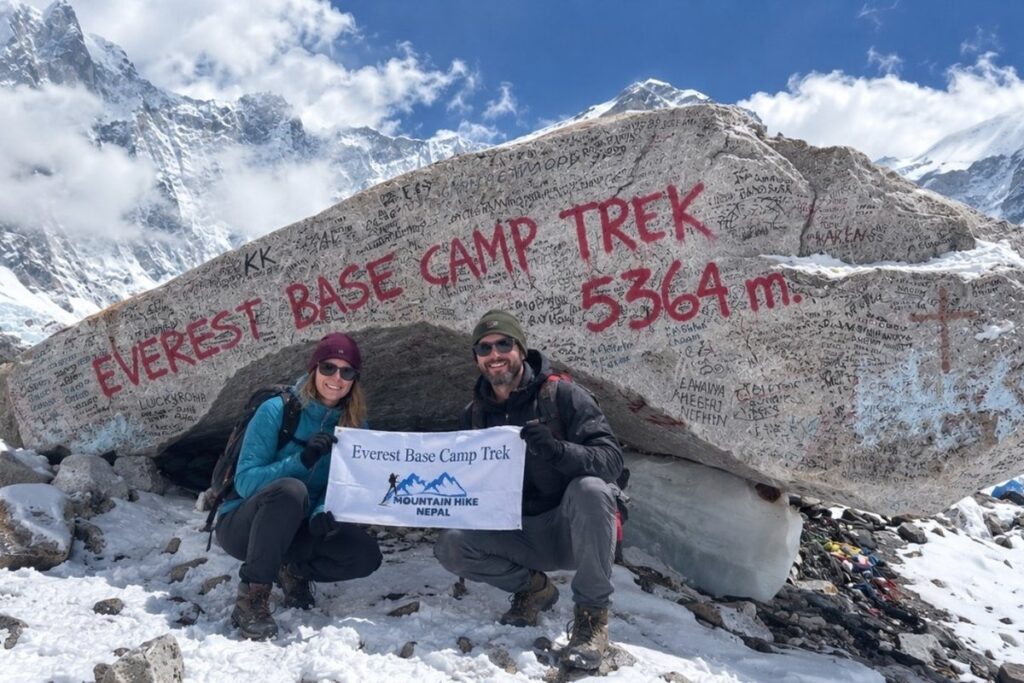
Lukla → Phakding → Namche Bazaar → Tengboche → Debuche → Dingboche → Lobuche → Gorak Shep → Everest Base Camp (5,364m) → Kala Patthar (5,644m) → Lobuche → Chukkung → Island Peak Base Camp (5,200m) → Island Peak Summit (6,189m) → Chukkung → Namche Bazaar → Lukla
This package gives you two trips for the price of one itinerary: the full Everest Base Camp experience, plus a genuine technical summit most EBC trekkers never attempt. You walk the same trail as every Base Camp group for the first nine days, then branch off toward Chukkung and a mountain of your own.
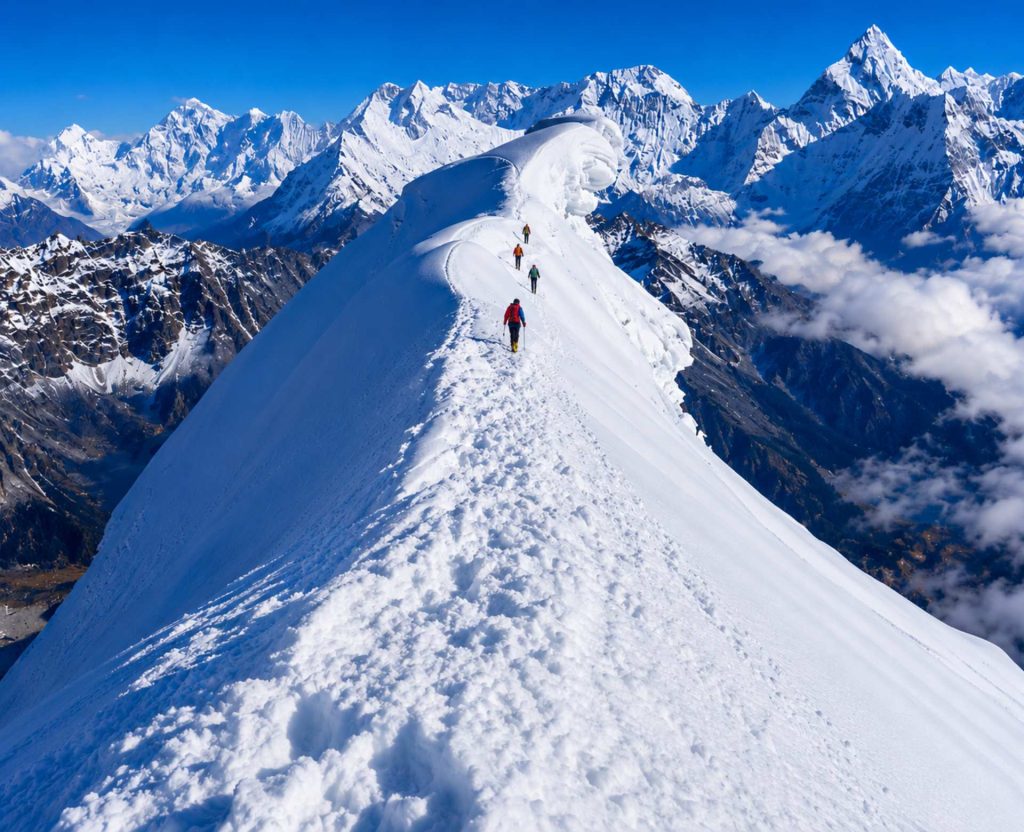
Island Peak’s standard North Ridge route is rated PD+ on the Alpine grading scale, reaching 6,189m from a Base Camp at roughly 5,200m — a single summit push with no separate High Camp required. The route crosses glacier terrain and a fixed-rope headwall below the summit ridge, with a short ladder crossing over the mountain’s main crevasse.
Compared to a standalone Island Peak expedition starting from Chukkung alone, this route gives you the full Khumbu acclimatization ladder — Namche, Dingboche, and Kala Patthar — before you ever reach Base Camp, which lowers your altitude risk going into the technical climb. If you’re deciding between peaks, see our Island Peak difficulty guide for the full technical breakdown.
This isn’t a casual add-on to a trek. Summit day is a long, cold push on fixed ropes above 5,200m, crossing glacier terrain and a crevasse before the final ridge — not difficult in the technical-climbing sense, but genuinely demanding at altitude after days of trekking fatigue. Go in with at least 8 weeks of structured training and realistic expectations about the cold, and this is one of the most achievable 6,000m summits in Nepal for a well-prepared first-time climber.
Peak Season (Spring: March–May | Autumn: September–November): Lukla flights operate from Manthali Airport in Ramechhap during these busiest months, not Kathmandu. Expect an early-morning 4–5-hour overland drive from Kathmandu to Ramechhap before the short flight to Lukla.
Off-Peak Season (Winter: December–February | Monsoon: June–August): Lukla flights generally operate directly between Kathmandu and Lukla in these months, subject to airline schedules and weather.
The Civil Aviation Authority of Nepal (CAAN) runs this seasonal arrangement to reduce congestion at Tribhuvan International Airport during peak season. It applies to every airline flying scheduled Lukla routes, including Tara Air, Summit Air, and Sita Air. We include the Ramechhap transfer in every package for this reason.
Build in 2 to 3 buffer days on your return schedule — a missed summit window from a weather delay is a bigger problem on this trip than on a standard trek, since your flight home shouldn’t be booked tighter than your climbing days allow.
Prefer to skip a flight leg entirely? A helicopter upgrade is available on request. A shared seat currently runs roughly $650–700 per person one way. Heli pricing moves with fuel costs and passenger numbers, so treat this as a current rate, not a locked-in figure. We can also arrange a return pickup from Chukkung, Dingboche, or Namche instead of walking all the way back to Lukla. See our full FAQ on Lukla flight alternatives below for the breakdown.
per person
per person
per person
per person
Altitude: 2,610m | Flight: 35 min | Trek: 3–4 hrs | Meals: Lunch, Dinner | Stay: Teahouse, Phakding
A short, scenic flight from Kathmandu drops you into Lukla’s mountain airstrip, one of the more memorable landings in trekking. From there it’s a gentle afternoon walk down to Phakding on the Dudh Koshi, a good warm-up before the climbing starts in earnest.
Altitude: 3,440m | Trek: 5–6 hrs | Meals: Breakfast, Lunch, Dinner | Stay: Teahouse, Namche Bazaar
The trail crosses several suspension bridges over the Dudh Koshi before a steep climb into Namche, the Khumbu’s unofficial capital. First real views of the high peaks open up on the approach, weather permitting.
Altitude: 3,440m | Hike: 3–4 hrs | Meals: Breakfast, Lunch, Dinner | Stay: Teahouse, Namche Bazaar
A short acclimatization hike up toward the Everest View Hotel gives your body a controlled dose of extra altitude before descending back to sleep at Namche — “climb high, sleep low,” the same rhythm every high-altitude itinerary depends on.
Altitude: 3,820m | Trek: 5–6 hrs | Meals: Breakfast, Lunch, Dinner | Stay: Teahouse, Debuche
The trail climbs to Tengboche, home to the Khumbu’s largest monastery and some of the best Everest and Ama Dablam views on the entire route, before a short drop to the quieter village of Debuche for the night.
Altitude: 4,410m | Trek: 5–6 hrs | Meals: Breakfast, Lunch, Dinner | Stay: Teahouse, Dingboche
The forest thins out as the trail climbs into the open Imja Valley. Dingboche sits well above the treeline, with your first proper views of Lhotse and Island Peak itself in the distance.
Altitude: ~5,000m | Hike: 3–4 hrs | Meals: Breakfast, Lunch, Dinner | Stay: Teahouse, Dingboche
A second acclimatization hike, this time up Nagarjun Hill above Dingboche. The climb is steep but short, and the panorama at the top — Makalu, Lhotse, and the Imja Valley spread out below — is one of the best viewpoints on the route for the effort involved.
Altitude: 4,910m | Trek: 5 hrs | Meals: Breakfast, Lunch, Dinner | Stay: Teahouse, Lobuche
The trail climbs along a ridge past the memorials to climbers lost on Everest, a sobering stretch, before dropping into Lobuche. The air is noticeably thinner here, and this is where the trip’s demands start to build.
Altitude: 5,644m | Total: 10–11 hrs | Meals: Breakfast, Lunch, Dinner | Stay: Teahouse, Lobuche
This is the longest, hardest trekking day of the trip — be honest with yourself about that going in. You trek to Gorak Shep, continue to Everest Base Camp (5,364m) and back, then climb Kala Patthar (5,644m) for the best close-up view of Everest’s summit pyramid on the route, before returning all the way down to Lobuche for the night. Pace yourself and drink more water than feels necessary; this day asks a lot before the technical climbing even begins.
Altitude: 4,730m | Trek: 5–6 hrs | Meals: Breakfast, Lunch, Dinner | Stay: Teahouse, Chukkung
The route leaves the main EBC trail behind and turns south into the quieter Chukkung valley. Island Peak comes into full view for the first time, and the crowds of the main trail thin out noticeably.
Altitude: ~5,200m | Trek: 3–4 hrs | Meals: Breakfast, Lunch, Dinner | Stay: Tented camp, Island Peak Base Camp
A short but steady climb brings you to Base Camp, where tents replace teahouses for the rest of the climb. The afternoon is spent on technical training with your climbing Sherpa — crampon technique, ice axe use, and practicing on the fixed ropes you’ll rely on the next day.
Altitude: 6,189m | Climb: 10–12 hrs | Meals: Breakfast, Lunch, Dinner | Stay: Teahouse, Chukkung
An early start, often before 2am, for the summit push. The route crosses glacier terrain and a crevasse — bridged by a fixed ladder — before a steep headwall on fixed ropes leads to the summit ridge. After the summit, you descend the same way and continue all the way down to Chukkung the same day, back in a teahouse bed that night.
Altitude: 4,730m | Meals: Breakfast, Lunch, Dinner | Stay: Teahouse, Chukkung
A built-in buffer day in case summit day needs to move for weather. If it isn’t needed, it’s a genuinely restful day before the descent begins — your legs will likely be grateful for it either way.
Altitude: 3,440m | Trek: 6–7 hrs | Meals: Breakfast, Lunch, Dinner | Stay: Teahouse, Namche Bazaar
A long descending day back through Tengboche and down to Namche. The air thickens noticeably with every hour, and it’s usually the first day of the trip that feels genuinely easy to breathe.
Altitude: 2,860m | Trek: 6–7 hrs | Meals: Breakfast, Lunch, Dinner | Stay: Teahouse, Lukla
The final trekking day retraces the route back to Lukla. A last night in the mountains before the flight out the next morning.
Flight: 35 min | Meals: Breakfast | Stay: Kathmandu (on your own)
A morning flight back to Kathmandu. Build 2 to 3 buffer days into your travel plans beyond this point — Lukla flights are the single most common source of delay on this trip, and your international departure shouldn’t be booked tighter than that risk allows.
Planning your climb? These guides cover the details that don’t fit on this page — exact costs, technical difficulty, and the best season to go.
No prior mountaineering experience is required, but you need to be a strong, confident trekker. Island Peak’s standard route is rated PD+ — technical, but not extreme — and the Base Camp training day covers crampon technique, ice axe use, and the fixed-rope and ladder sections you’ll climb on summit day. If you’ve never worn crampons or used a climbing harness before, tell us before booking so we can plan extra practice time into your training day.
The NMA (Nepal Mountaineering Association) climbing permit for Island Peak falls under the standard Group B peak fee band. Nepal’s most recent fee revision took effect in September 2025, and the current band is $350 for spring, $175 for autumn, and $175 for winter and summer — replacing older $250 / $125 / $70 figures still quoted on some other sites. We confirm the exact current rate with the NMA before your trip is finalized.
Yes. The trekking portion follows the same trail as our Everest Base Camp Trek, so the walking difficulty is comparable. What EBC doesn’t have is the technical climbing above Base Camp — crampons, a harness, fixed ropes, a ladder crossing over a crevasse, and a summit day that can run 10 to 12 hours round trip. If you’ve done EBC and are deciding whether to add Island Peak, the climb is a real step up in physical demand and risk, not just a few extra days on the same trail.
Both are NMA-regulated peaks in the Khumbu, both rated PD+, and both climbed from a similar Base Camp approach. The real differences: Island Peak sits higher (6,189m vs Lobuche’s 6,119m), and its route adds a glacier crossing with a fixed ladder over a crevasse that Lobuche’s route doesn’t have. Our research found both peaks share the same PD+ grade on their standard routes, despite some older comparisons rating Lobuche as easier — we’re rebuilding our full Island Peak vs Lobuche comparison guide to reflect this and will link it here once it’s live.
Group climbing equipment — harness, helmet, crampons, ice axe, and rope — is provided as part of the package. What you need to bring yourself is personal clothing and equipment: climbing boots, a warm down jacket, and a sleeping bag rated well below freezing. All of these are rentable in Kathmandu if you’d rather not buy or fly with them.
Yes, a guide is mandatory. Every climber on an NMA-regulated peak must be accompanied by a licensed climbing guide, and we don’t offer Island Peak as a self-guided climb. Beyond the permit requirement, the route includes glacier travel and a crevasse crossing — not terrain to manage on your own on a first attempt.
Start training at least 8 weeks before you fly. You need a solid cardiovascular base, the kind that comes from regular hiking, running, or cycling, plus leg strength for sustained climbing with a pack, since you’ll walk 5 to 7 hours most days before the technical climbing even starts. If you can comfortably complete a multi-hour hike on consecutive days while carrying 5 to 8kg, you’re in a reasonable starting position.
Day 8 of this itinerary (Lobuche → Gorak Shep → Everest Base Camp → Kala Patthar → back to Lobuche) is a long day — 10 to 11 hours of trekking above 5,000m. Most Everest Base Camp itineraries split this into two separate days. We keep it combined here because the schedule needs the extra day elsewhere, as a contingency day for the summit push. If a long single day at altitude concerns you, especially on a first high-altitude trip, tell us before booking — we can rebuild your itinerary to split the two into separate days, which adds a day to the trip.
Day 12 of the itinerary is a built-in contingency day at Chukkung for exactly this. If the weather window for the summit push closes on Day 11, the climb can move to Day 12 instead. If the weather doesn’t clear within that window either, the summit attempt may need to be called off — no guide can safely push a summit attempt into genuinely bad weather on technical terrain. This is a real possibility on any Himalayan peak climb, not something any operator can promise away.
Some Island Peak itineraries include a separate High Camp between Base Camp and the summit. Ours goes directly from Base Camp to the summit in one push, which is the more common approach on this peak’s standard route and keeps the overall schedule tighter. It does mean a longer single push on summit day — 10 to 12 hours — rather than splitting it across two shorter days, worth knowing if you’re comparing itineraries from different operators.
If you’d rather not fly, the only real alternative is trekking out via the classic Jiri or Shivalaya route instead of flying from Lukla — adding 4 to 6 extra trekking days with no flight in either direction. Most climbers don’t choose this given the extra time, since Island Peak’s own schedule already runs 15 days. The more common choice, if you just want to skip the return flight, is the helicopter upgrade covered above.