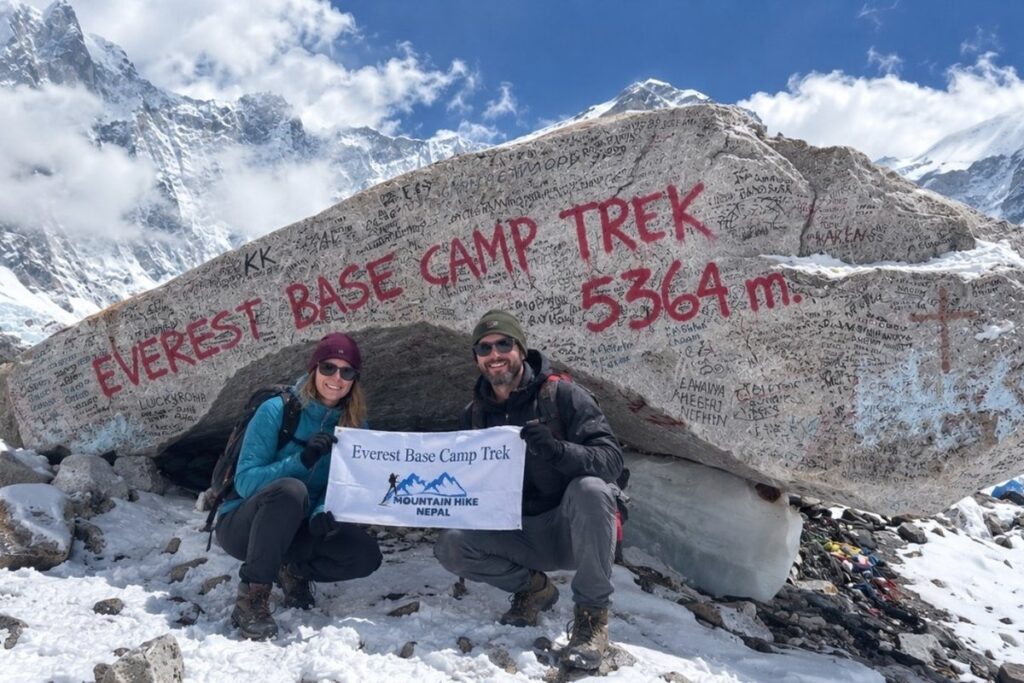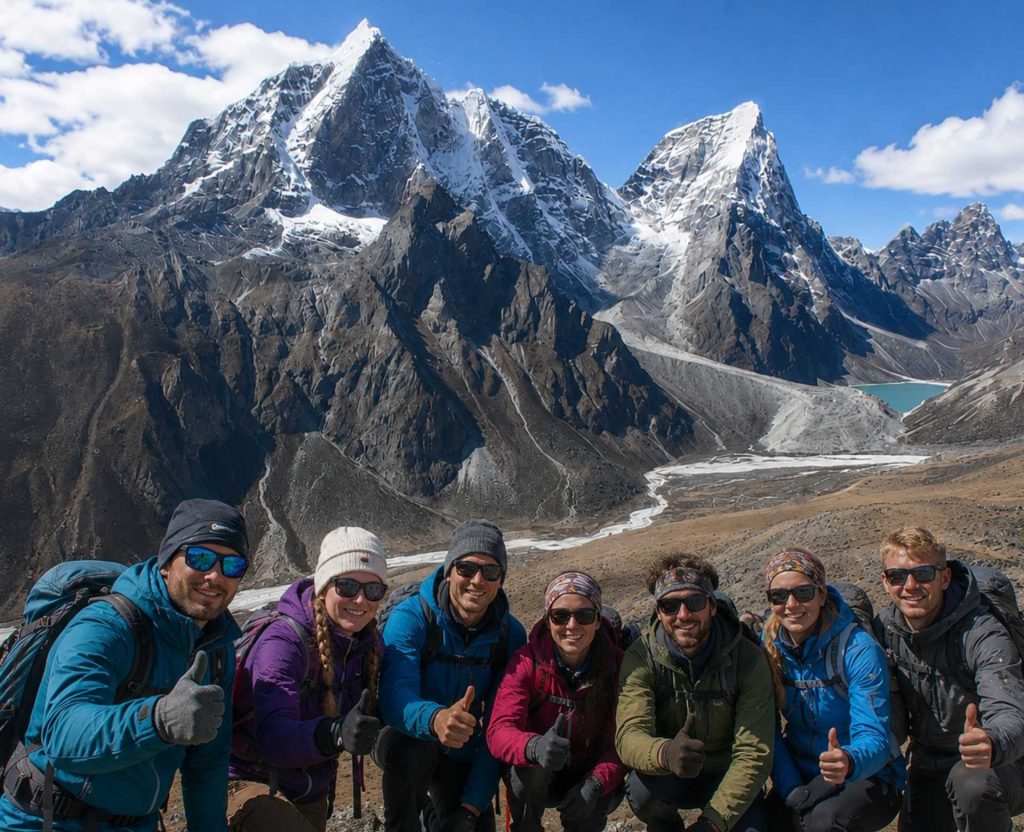
Lobuche Peak Climbing Trek is a 16-day Khumbu expedition from Lukla combining the classic Everest Base Camp route with a technical climb of Lobuche East (6,119m), priced from $1,899 to $2,849 per person. The route passes Namche Bazaar, Tengboche, and Dingboche to Everest Base Camp (5,364m) and Kala Patthar (5,644m) before turning toward Lobuche Base Camp.
The first ten days feel like any EBC trek — teahouses, prayer flags, yak trains. The shift comes at Lobuche Base Camp: a tented camp, fixed-line training, then a 3am summit push.
Acclimatisation at Namche and Dingboche comes before the technical days, which is what makes this climb realistic without prior experience. See our difficulty guide for physical prep, or our cost guide for the full budget.
Mountain Hike Nepal has run Khumbu treks and climbs from Kathmandu since 2018, arranging all three permits, group climbing equipment, and a dedicated climbing Sherpa. Check our cost breakdown or message us on WhatsApp with your travel month.
| Trip Details | Information |
|---|---|
| Trip Name | Lobuche Peak Climbing Trek |
| Duration | 15 Nights / 16 Days |
| Maximum Altitude | 6,119m — Lobuche East Summit |
| Major Highlights | Lobuche East Summit (6,119m), Everest Base Camp (5,364m), Kala Patthar (5,644m), Namche Bazaar, Tengboche Monastery |
| Trek Difficulty | Challenging — High-Altitude Trekking Plus a Basic Technical Climb |
| Trek Start / End Point | Lukla |
| Best Season | Spring (March–May) and Autumn (September–November) |
| Low Season | Winter — colder temperatures, fewer climbers |
| Not Recommended | Monsoon Season (June–August) |
| Accommodation | Teahouse Lodges, With Tented Camps at Base Camp and High Camp |
| Meals Included | Breakfast, Lunch and Dinner |
| Trek Style | Guided High-Altitude Trekking and Peak Climbing |
| Region | Everest (Khumbu), Nepal |
| Permits Required | Sagarmatha National Park, Khumbu Pasang Lhamu Rural Municipality, NMA Lobuche East Climbing Permit |
| Climbing Equipment | Harness, Helmet, Crampons, Ice Axe, and Rope — Provided as Group Equipment |
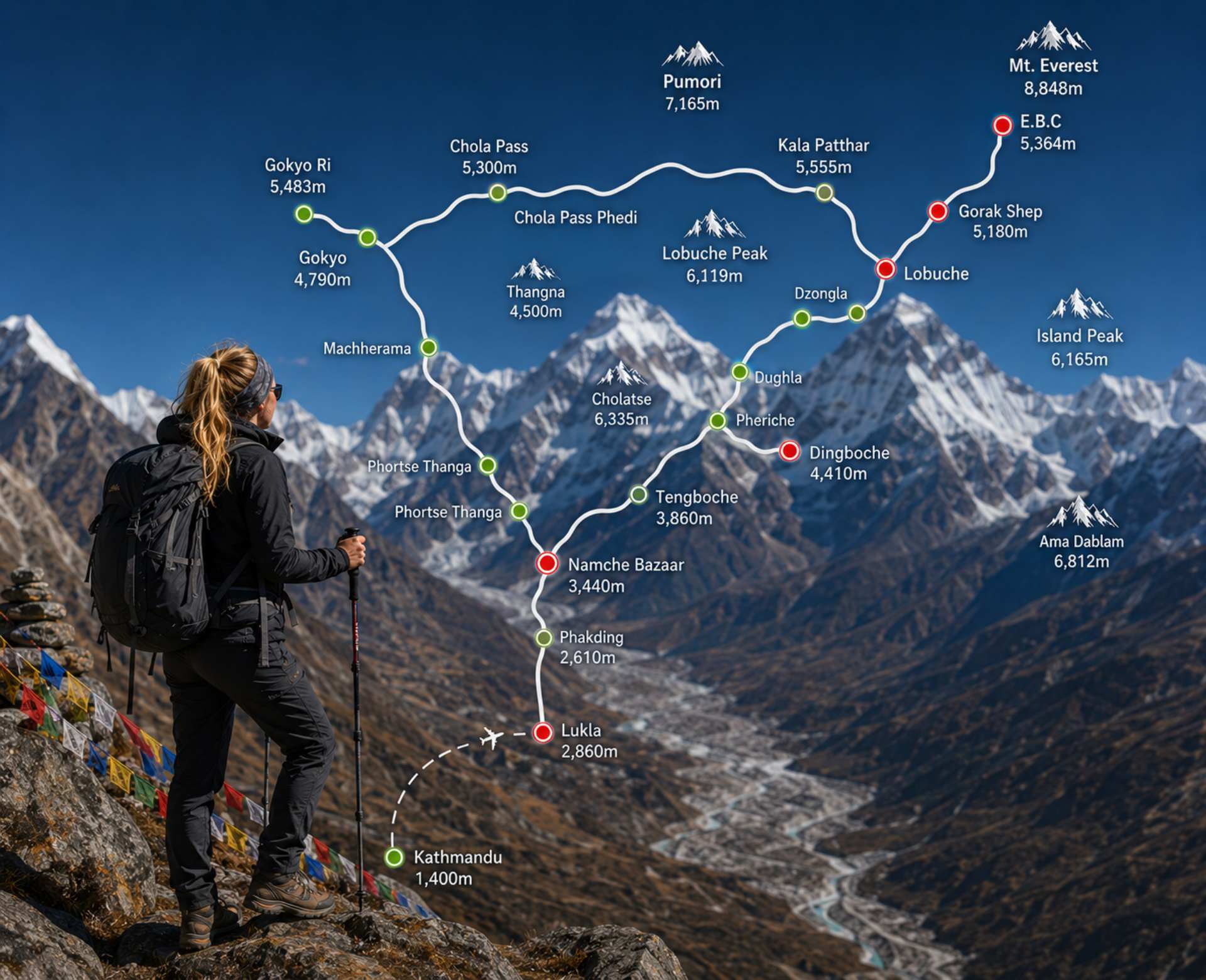
Lukla → Phakding → Namche Bazaar → Tengboche → Debuche → Dingboche → Lobuche → Gorak Shep → Everest Base Camp (5,364m) → Kala Patthar (5,644m) → Lobuche Base Camp → High Camp → Lobuche East Summit (6,119m) → Pheriche → Namche Bazaar → Lukla
Lobuche Peak Climbing Trek follows the same trail every Everest Base Camp trekker walks, then keeps going. You get the full Khumbu approach — the swinging bridges above the Dudh Kosi, Tengboche’s monastery courtyard, the first sight of Everest from Kala Patthar — and then a second trip, a shorter one, into mountaineering.
The climbing phase starts at Lobuche Base Camp (4,940m), reached on day 10, with fixed-line training run by your climbing Sherpa that same afternoon. Day 11 moves up to High Camp (5,510m) to shorten the summit push, which starts around 3am on day 12 — 10 to 12 hours round trip to the top of Lobuche East at 6,119m.
Against Island Peak Climbing, Lobuche East is the gentler introduction — lower, shorter summit day, and a route that stays closer to standard EBC trekking terrain until the final stretch. Trekkers weighing the two should see our Lobuche vs. Island Peak comparison guide before booking either one.
Be honest with yourself about the physical side before booking. Summit day starts around 3am and runs 10 to 12 hours round trip, on steep snow and fixed lines, at temperatures around -10°C to -15°C at Gorak Shep and colder at High Camp. The technical skills are taught on-site in a single training day — the real limiter is altitude and endurance, not climbing experience. We recommend 8 to 10 weeks of cardio and leg-strength training beforehand, and this isn’t the trip to start building fitness on the trail.
Peak Season (Spring: March–May | Autumn: September–November): Lukla flights operate from Manthali Airport in Ramechhap during these busiest months, not Kathmandu. Expect an early-morning 4–5-hour overland drive from Kathmandu to Ramechhap before the short flight to Lukla.
Off-Peak Season (Winter: December–February | Monsoon: June–August): Lukla flights generally operate directly between Kathmandu and Lukla in these months, subject to airline schedules and weather.
The Civil Aviation Authority of Nepal (CAAN) runs this seasonal arrangement to reduce congestion at Tribhuvan International Airport during peak season. It applies to every airline flying scheduled Lukla routes, including Tara Air, Summit Air, and Sita Air. We include the Ramechhap transfer in every package for this reason.
Build in 2 to 3 buffer days on your return schedule — a missed summit window from a weather delay is a bigger problem on this trip than on a standard trek, since your flight home shouldn’t be booked tighter than your climbing days allow.
Prefer to skip a flight leg entirely? A helicopter upgrade is available on request. A shared seat currently runs roughly $650–700 per person one way. Heli pricing moves with fuel costs and passenger numbers, so treat this as a current rate, not a locked-in figure. We can also arrange a return pickup from Pheriche, Dingboche, or Namche instead of walking all the way back to Lukla. See our full FAQ on Lukla flight alternatives below for the breakdown.
per person
Recommended
per person
per person
Value Added
per person
Altitude: 2,610m | Flight: 35 min | Trek: 3–4 hrs | Meals: Lunch, Dinner | Stay: Teahouse, Phakding
The flight to Lukla is short and sharp — a runway cut into a hillside, mountains on both sides, and noticeably thinner air the moment you step off the plane. From there the trail follows the Dudh Kosi downstream through pine forest and small Sherpa villages to Phakding. We keep today’s walking light on purpose; your body just jumped a lot of elevation on that flight, and an easy first afternoon matters more than covering distance.
Altitude: 3,440m | Trek: 5–6 hrs | Ascent: +638m | Meals: Breakfast, Lunch, Dinner | Stay: Teahouse, Namche Bazaar
This is the day that actually feels like climbing. Multiple suspension bridges carry the trail back and forth across the Dudh Kosi, the route enters Sagarmatha National Park at Jorsale, and the last hour is a steep, switchbacking push into Namche. Most people spot Everest for the first time through a gap in the ridgeline just below town — there and gone in a few steps. You’ll have two nights in Namche’s horseshoe of teahouses and gear shops.
Altitude: 3,440m overnight / 3,880m hike | Hike: 3–4 hrs | Meals: Breakfast, Lunch, Dinner | Stay: Teahouse, Namche Bazaar
A morning hike up to the Everest View Hotel ridge — Everest, Lhotse, Ama Dablam, and Thamserku all in one frame on a clear day — then back down to Namche to sleep at the same altitude. This isn’t a rest day for the sake of it: your body genuinely needs 24 to 48 hours here before going higher. Use the afternoon for a gear check with your climbing guide, since this is also when we go over what’s ahead on the technical days.
Altitude: 3,820m | Trek: 5–6 hrs | Meals: Breakfast, Lunch, Dinner | Stay: Teahouse, Debuche
Out of Namche through rhododendron forest to Tengboche, home to the largest and most photographed monastery in the Khumbu, framed by Ama Dablam on one side and Everest on the other. Arrive before midday if you can, while the light holds and before afternoon cloud rolls in. From Tengboche the trail drops through forest to Debuche for the night.
Altitude: 4,410m | Trek: 5–6 hrs | Ascent: +590m | Meals: Breakfast, Lunch, Dinner | Stay: Teahouse, Dingboche
Past Pangboche the trees give out and the terrain turns properly alpine. The trail passes Ama Dablam Base Camp before opening onto Dingboche, a wide high valley with Ama Dablam, Lhotse, and Island Peak all visible at once. Eat a full dinner and drink plenty of water tonight — tomorrow’s acclimatisation hike matters more than almost any other day on this trip.
Altitude: 5,000m hike / 4,410m overnight | Hike: 4–5 hrs | Meals: Breakfast, Lunch, Dinner | Stay: Teahouse, Dingboche
We climb Nagarjun Hill to roughly 5,000m — your first time past that mark — for a wide panorama taking in Ama Dablam, Lhotse, Makalu, Baruntse, and Chamlang. Sleeping back down at 4,410m after touching 5,000m is climb-high-sleep-low in practice, and it’s the single most useful thing you’ll do to prepare your body for the altitude still ahead.
Altitude: 4,910m | Trek: 4–5 hrs | Meals: Breakfast, Lunch, Dinner | Stay: Teahouse, Lobuche
A shorter day, deliberately. The trail climbs past the stone memorial cairns built for climbers lost on Everest, a quiet and sobering stretch, before dropping into Lobuche. The village itself is small and basic, but it’s the last proper teahouse stop before Gorak Shep — and your body will be glad of the short mileage after yesterday’s hike.
Altitude: 5,164m overnight / 5,364m Base Camp | Trek: 7–8 hrs | Meals: Breakfast, Lunch, Dinner | Stay: Teahouse, Gorak Shep
The long day. The trail crosses glacial moraine to Gorak Shep, where you drop your pack before continuing on to Everest Base Camp itself. There’s no view of the summit from here — Base Camp sits under the Khumbu Icefall, not facing it — but standing on the Khumbu Glacier at the literal base of the mountain is a different kind of moment than any viewpoint. Back to Gorak Shep for the night.
Altitude: 5,644m high point / 4,910m overnight | Total: 6–7 hrs | Meals: Breakfast, Lunch, Dinner | Stay: Teahouse, Lobuche
A pre-dawn climb up Kala Patthar for sunrise over Everest’s southwest face, with Nuptse, Lhotse, and Pumori filling out the rest of the horizon — the best Everest view on the whole trip, and the highest point you’ll reach before the climbing phase starts. We descend back to Gorak Shep and continue on to Lobuche, setting up for tomorrow’s move into the climbing zone.
Altitude: 4,940m | Trek: 3–4 hrs | Meals: Breakfast, Lunch, Dinner | Stay: Tented Camp, Lobuche Base Camp
A short trek to Base Camp, where the trip shifts from trekking to climbing. Tents replace teahouses from here. Your climbing Sherpa runs fixed-line and gear training that same afternoon — harness, crampons, ice axe, how to move on a jumar — regardless of prior climbing experience. This is also when your summit-day equipment gets checked piece by piece.
Altitude: 5,510m | Trek: 3–4 hrs | Meals: Breakfast, Lunch, Dinner | Stay: Tented Camp, High Camp
A short, deliberately easy move up to High Camp, which exists purely to shorten summit day. Expect an early dinner and an early tent time — the wake-up call tonight comes well before midnight, and conserving energy here matters more than anything else on the schedule.
Altitude: 6,119m summit / 4,240m overnight | Climb: 10–12 hrs | Meals: Breakfast, Lunch, Dinner | Stay: Teahouse, Pheriche
Summit day starts around 3am. The route climbs steep snow and glacier terrain on fixed lines to the summit ridge, with Everest, Makalu, and Cho Oyu visible from the top on a clear day. After the summit, the team descends all the way past High Camp and Base Camp to Pheriche the same day — a long, demanding push, but getting back down to thicker air matters more than stopping early.
Altitude: 4,240m | Meals: Breakfast, Lunch, Dinner | Stay: Teahouse, Pheriche
A built-in reserve day, held for bad weather, a delayed summit attempt, or simply recovery. If the summit went to plan on Day 12, this becomes a genuine rest day in Pheriche before the walk out resumes. If the weather pushed the summit attempt back, this is the day that absorbs the delay without rearranging your flights home.
Altitude: 3,440m | Trek: 6–7 hrs | Meals: Breakfast, Lunch, Dinner | Stay: Teahouse, Namche Bazaar
Back down through Tengboche and the rhododendron forest to Namche. Breathing eases noticeably below 4,000m, and energy comes back faster than most people expect. Namche’s hot showers and reliable electricity feel well earned after the climb — use the evening to recharge gear and tip your climbing Sherpa and porters in cash before the group splits up tomorrow.
Altitude: 2,860m | Trek: 5–6 hrs | Meals: Breakfast, Lunch, Dinner | Stay: Teahouse, Lukla
The final trekking day follows the lower Dudh Kosi valley back to Lukla, crossing the Hillary Suspension Bridge on the way. Confirm your morning flight time with your guide the night before, and keep your pack within the domestic carry-on limit.
Flight: 35 min | Meals: Breakfast
A short flight back to Kathmandu closes out the trip — sixteen days, a Himalayan base camp, and a real summit.
Important: build 2 to 3 buffer days into your Kathmandu schedule after this flight. Lukla flights run on weather, not timetables, and delays are common enough that we plan around them. Never book an international connection for the same day or the day right after your return.
A 16-day Khumbu expedition from Lukla that pairs the classic Everest Base Camp trek with a technical climb of Lobuche East (6,119m), one of Nepal’s NMA-registered trekking peaks. The route passes through Namche Bazaar, Tengboche, and Dingboche to Everest Base Camp and Kala Patthar before turning into the climbing phase at Lobuche Base Camp and High Camp. No prior climbing experience is required — the fixed-line skills needed are taught on a dedicated training day. Packages run from $1,899 to $2,849 per person depending on group size.
Yes, round-trip Lukla flights and the Ramechhap transfer are included in every tier. If weather cancels a flight, we work with the airline to rebook you on the next available slot, and if your summit window is genuinely at risk, we’ll discuss a helicopter option instead. Build 2 to 3 buffer days into your return schedule for this reason — a missed summit window is a bigger problem on this trip than on a standard trek.
During spring and autumn, Nepal’s Civil Aviation Authority reroutes all scheduled Lukla flights through Manthali Airport in Ramechhap to ease congestion at Tribhuvan International Airport. That means an early-morning 4 to 5-hour drive from Kathmandu to Ramechhap before the short flight to Lukla. It applies to every airline on the route, not just ours, and we include the transfer in every package.
Three — the Sagarmatha National Park entry permit, the Khumbu Pasang Lhamu Rural Municipality permit, and your NMA Lobuche East climbing permit. All three are included in our package price. Your climbing guide carries and presents the paperwork at every checkpoint and with the NMA liaison officer.
Our package runs from $1,899 per person for groups of 8–12 up to $2,849 for solo climbers, covering Lukla flights, all three permits, climbing equipment, teahouse and tented-camp accommodation, and a dedicated climbing Sherpa. Add international flights, the $50 Nepal visa, mountaineering insurance, and the refundable $500 NMA garbage deposit and your total all-in budget runs higher. Full breakdown: Lobuche Peak Climbing cost guide →
No. Lobuche East is an NMA trekking peak specifically because it doesn’t require a technical climbing background — fitness and acclimatisation matter more than rope skills. The one full training day at Base Camp covers everything you need: using a harness, crampons, an ice axe, and moving safely on fixed lines. What it does demand is comfort with long trekking days above 4,000m first.
Group technical gear — harness, helmet, crampons, ice axe, and rope — is included and provided at Base Camp. You’re responsible for personal cold-weather gear: a sleeping bag rated to around -15°C, a good down jacket, and mountaineering boots compatible with crampons. Most of this is rentable in Kathmandu if you don’t want to buy and fly with it.
Autumn (September to November) and spring (March to May) are the two climbing seasons, with October and April generally giving the most stable weather windows. Winter is quieter but colder, and we don’t recommend attempting this during the June–August monsoon, when cloud cover and snow conditions make the summit push genuinely unsafe.
It’s the same first ten days as our standard EBC Trek, then four additional days for the climbing phase — Base Camp, High Camp, the summit push, and a contingency day — before rejoining the standard return route. Lobuche East adds a real 6,119m summit and a harder, longer trip; EBC alone tops out at Kala Patthar’s 5,644m with no technical climbing at all. See our Lobuche vs. Island Peak guide if you’re also weighing a bigger technical objective.
Summit day starts around 3am from High Camp and runs 10 to 12 hours round trip, climbing steep snow and glacier terrain on fixed lines to the summit ridge. It’s physically demanding more than technically complex — your climbing Sherpa manages the rope work, and your job is pacing, hydration, and putting one foot in front of the other at altitude.
Gorak Shep, at 5,164m, where you’ll overnight before and after the Everest Base Camp and Kala Patthar days — expect temperatures around -10°C to -15°C in October and November. High Camp, at 5,510m, is colder still but only one night, right before the summit push.
Travel and medical insurance covering mountaineering to at least 6,200m and helicopter evacuation, confirmed before we finalise your booking. Rescue from this altitude typically costs $8,000 to $15,000 without it, so this isn’t optional paperwork — we check your policy ourselves rather than just asking you to confirm you have one.
It’s a $500 refundable deposit required by the Nepal Mountaineering Association for every expedition team, not per climber — solo climbers pay the same $500 as a group of 12. You get it back once your team’s waste is confirmed carried back down and the clearance certificate is submitted, which we handle on your behalf.