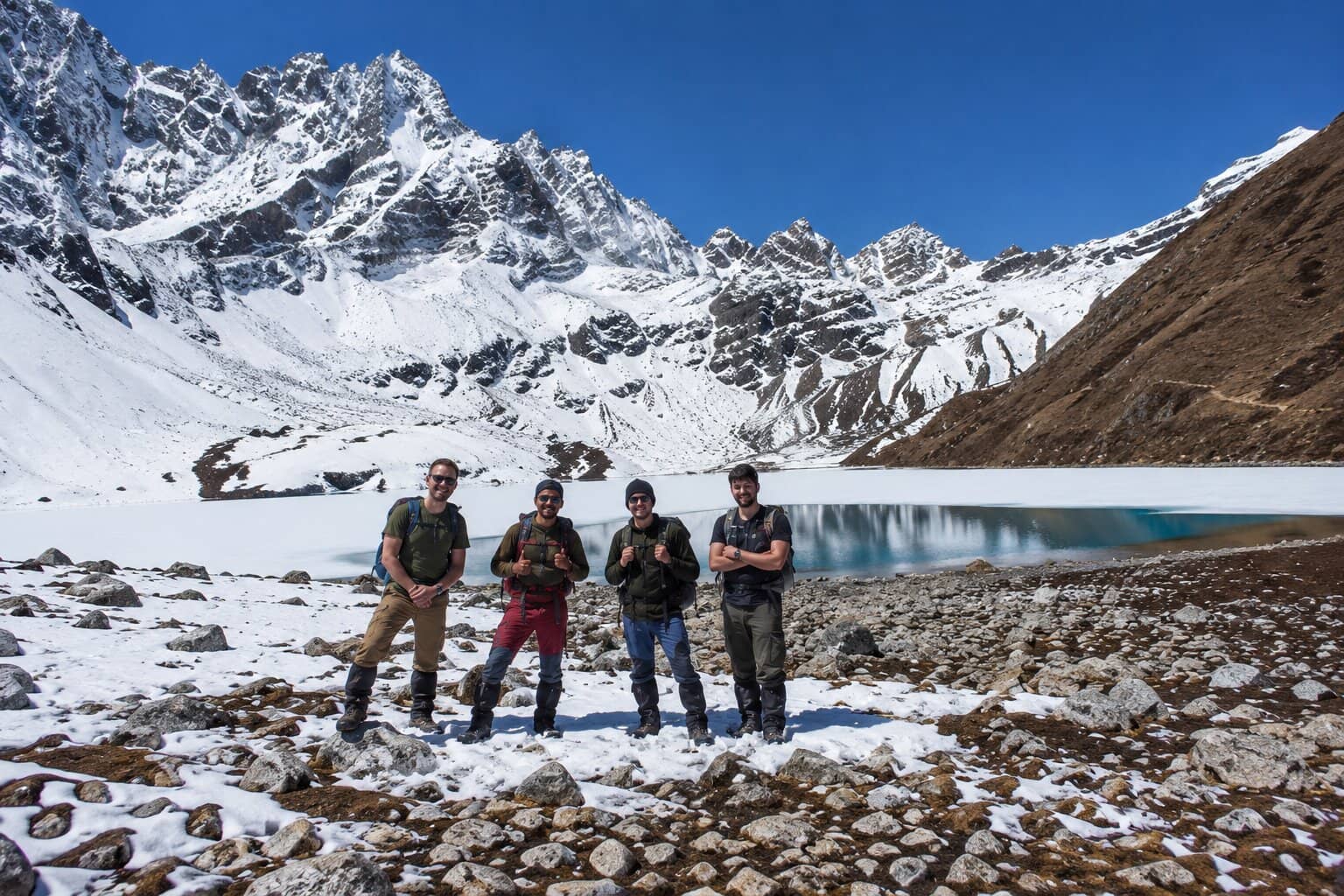
The Everest Gokyo Lakes Trek is moderate to challenging — similar in effort to Everest Base Camp, but with a lower altitude ceiling. There’s no technical climbing anywhere on the route, no rope work, no glacier crossing. What makes it hard is 11 days of sustained walking above 3,400m, a pre-dawn climb to Gokyo Ri (5,357m), and two nights sleeping at 4,750m. A first-time trekker with real fitness preparation can do this trek. Someone hoping to wing it on general gym fitness usually struggles.
What’s Inside This Guide
- Can a First-Time Trekker Do This Trek?
- Fitness Level Required
- Daily Walking Hours
- What Actually Makes This Trek Difficult
- Who Should Slow Down, Not Rush
- Practical Preparation Before You Fly
- How This Compares to EBC on Difficulty
- Gokyo Lakes vs Other Nepal Treks
- Frequently Asked Questions
- Related Planning Guides
Can a First-Time Trekker Do the Gokyo Lakes Trek?
Yes, for a first-timer who actually prepares. This isn’t a technical route — the trail is well-marked and well-walked the whole way, teahouses line every overnight stop, and your guide handles permits, navigation, and altitude decisions. Many first-time trekkers complete this route successfully each season.
What matters far more than prior trekking experience is fitness preparation before you fly, and a willingness to walk at your own pace rather than someone else’s. Trekkers who arrive undertrained and try to keep up with a faster group are the ones who struggle here, not first-timers as a category.
Fitness Level Required
Six to eight weeks of real uphill training before you fly out makes a genuine difference in how the route feels. Hiking with a loaded daypack, stair climbing, and steady cardio (running, cycling, swimming) three to four times a week is the baseline most trekkers who finish comfortably report doing beforehand.
You don’t need mountaineering fitness or a climbing background. You need the ability to walk five to seven hours on consecutive days, uphill, at altitude, without your legs or your lungs giving out halfway through the day. Gym fitness alone — treadmill cardio, weight training with no hiking specificity — often doesn’t translate well to this kind of sustained, uneven-terrain walking.
Daily Walking Hours
| Day | Route | Walking Time |
|---|---|---|
| 1 | Lukla to Phakding | 3–4 hours |
| 2 | Phakding to Namche Bazaar | 5–6 hours |
| 3 | Acclimatisation hike, Namche | 3–4 hours |
| 4 | Namche to Dole | 5–6 hours |
| 5 | Dole to Machhermo | 3–4 hours |
| 6 | Machhermo to Gokyo | 3–4 hours |
| 7 | Gokyo Ri sunrise climb | 4–5 hours |
| 8 | Gokyo to Namche Bazaar | 6–7 hours |
| 9 | Namche to Phakding | 4–5 hours |
| 10 | Phakding to Lukla | 3–4 hours |
| 11 | Fly Lukla to Kathmandu | — |
Day 8 is the longest on the trail — six to seven hours descending from Gokyo back to Namche in one push. It’s not technically hard, but it comes right after the Gokyo Ri climb the day before, so tired legs are normal by the afternoon.
What Actually Makes This Trek Difficult
Not the terrain. The trail itself is a well-established teahouse route with no scrambling, no exposed ledges, and no need for ropes or crampons anywhere on the standard itinerary.
- Altitude. You sleep at 4,750m for two nights at Gokyo, and the Gokyo Ri climb tops out at 5,357m. Reduced oxygen makes every uphill step noticeably harder than the same effort at sea level.
- Cumulative fatigue. It’s 11 days of walking back to back, with only one full rest day (Namche, Day 3). Tired legs by Day 6 or 7 are normal, not a sign something’s wrong.
- Cold. Nights at Gokyo regularly drop well below freezing outside peak season. A poor sleeping bag or thin layers make the altitude feel worse than it is.
- The early alarm. The Gokyo Ri summit push starts around 4:30am in the dark and cold, on legs that already have six trekking days in them.
Who Should Slow Down, Not Rush
Anyone who notices a headache, disrupted sleep, or loss of appetite above 3,500m should slow down and say so — to their guide, immediately, not after it gets worse. This isn’t unusual and isn’t a sign of weak fitness; altitude affects fit and unfit trekkers differently and unpredictably.
Trekkers over roughly 50, anyone with a known heart or lung condition, and anyone who has had altitude sickness on a previous trek should talk to a doctor about this specific route before booking. The itinerary’s acclimatisation days exist for a reason — skipping or rushing them is the single biggest self-inflicted risk on this trek.
Practical Preparation Before You Fly
- Start uphill training 6–8 weeks out — hills, stairs, or a loaded pack on a treadmill incline if you’re somewhere flat
- Break in your trekking boots on actual hikes, never straight out of the box
- Get travel insurance that explicitly covers trekking at 5,357m and helicopter evacuation
- Learn the early symptoms of altitude sickness before you go, not on the trail for the first time
- Pack a sleeping bag rated to at least -15°C — nights at Gokyo are genuinely cold
- Tell your guide about every symptom the moment it starts, not once it’s already a problem
How This Compares to EBC on Difficulty
Similar effort, slightly lower altitude ceiling. EBC’s highest overnight is Gorak Shep at 5,164m, with a pre-dawn push to Kala Patthar at 5,644m. Gokyo’s highest overnight is Gokyo village at 4,750m, with a pre-dawn push to Gokyo Ri at 5,357m — roughly 300m lower on both counts. EBC also runs one day longer.
Neither difference makes Gokyo meaningfully easier day to day — the walking hours and the fitness demand are close to identical. What it does mean is a slightly gentler sleeping altitude for two nights, which some trekkers with borderline altitude tolerance find noticeably more comfortable. Full comparison: Gokyo vs EBC Comparison.
Gokyo Lakes vs Other Nepal Treks
| Trek | Max Altitude | Difficulty | Technical? | Days |
|---|---|---|---|---|
| Everest Gokyo Lakes Trek | 5,357m (Gokyo Ri) | Moderate–Hard | No | 11 |
| Everest Base Camp | 5,644m (Kala Patthar) | Moderate–Hard | No | 12 |
| Annapurna Base Camp | 4,130m | Moderate | No | 10 |
| Langtang Valley | 4,773m (Kyanjin Ri) | Moderate | No | 8 |
| Everest Three Passes | 5,535m (Kongma La) | Hard | No | 18 |
| Manaslu Circuit | 5,160m (Larkya La) | Hard | No | 14 |
| Island Peak Climbing | 6,189m | Very Hard | Yes — fixed ropes | 17 |
Gokyo Lakes sits at the same difficulty tier as EBC — both are moderate-to-hard, non-technical, high-altitude lodge treks. Three Passes and Manaslu Circuit are a step up, adding multiple high passes or a longer, more remote circuit. Island Peak is a different category entirely — it’s a climb, not a trek, and needs fixed-rope training regardless of trekking fitness.
Frequently Asked Questions
No. Previous multi-day trekking experience helps you know your own pace, but it isn’t required. What matters more is 6–8 weeks of specific uphill fitness training before you fly, since that’s what actually determines how the daily walking hours feel at altitude.
No technical skills or equipment are needed — no ropes, no crampons, no scrambling. The climb from Gokyo to Gokyo Ri is a steep but straightforward trail. The difficulty is entirely about altitude and the early, cold start, not the terrain itself.
Report symptoms to your guide immediately — mild symptoms usually mean resting a day or descending slightly, not abandoning the trek. If symptoms worsen, your guide will recommend further descent or, in a serious case, helicopter evacuation, which your travel insurance needs to cover for this route’s altitude.
Yes, noticeably. The Everest View Trek is a 5-day trip topping out at 3,880m with no nights above 4,000m — a genuine introduction to Himalayan trekking. Gokyo Lakes is 11 days, sleeps at 4,750m, and climbs to 5,357m, which puts it in a different difficulty category entirely.
Related Planning Guides
- Everest Gokyo Lakes Trek Altitude and Acclimatization
- Gokyo Ri Climb Difficulty
- Everest Gokyo Lakes Trek Cost
- Gokyo vs EBC Comparison
- Acclimatisation in Nepal Trekking
- Everest View Trek — A Gentler Introduction
Prepare Right, Trek With Confidence
This trek is genuinely achievable for a well-prepared first-timer — 6–8 weeks of uphill training and honest pacing on the trail matter more than prior trekking experience. See the full Everest Gokyo Lakes Trek package → or message us on WhatsApp with your fitness background and we’ll tell you honestly whether this route fits.
[…] Everest Gokyo Lakes Trek Difficulty for Beginners […]
[…] Everest Gokyo Lakes Trek Difficulty for Beginners — is Gokyo the right first Everest trek […]